The Science of Caring WellJanuary 16, 2026 · 16 min read
Abstract: Research reveals a counterintuitive truth about stress management: focusing on helping others is more effective than focusing on yourself. The "tend and befriend" response, mediated by oxytocin, creates neurological states of hope and courage that self-focused stress reduction cannot replicate. This article explores two decades of research demonstrating that compassionate caring for others transforms our own stress physiology, protects against the health consequences of difficult life events, and may be our most powerful resource against burnout and despair. Critically, these benefits require genuine compassion, not mere empathy, and are blocked when fears, beliefs, or resistance prevent compassion from flowing freely. For healthcare providers, understanding this distinction offers a path to sustainable caring that doesn't require caring less, but caring differently.
Read Time: 15 minutes or [ Listen on Speechify ]
In my previous post on empathy versus compassion, I explored how what we call "compassion fatigue" is actually a misnomer. The exhaustion healthcare providers experience doesn't come from too much compassion; it comes from too much empathy. But there's another piece to this puzzle that deserves its own examination: what happens biologically when we choose to care for others during stress?
The answer, supported by two decades of research, is remarkable. Caring for others doesn't just avoid depleting us. It actively transforms our stress physiology in ways that promote resilience, hope, and even physical health.
But here's the crucial caveat: this transformation requires genuine compassion, not empathy. And the benefits are blocked when internal barriers prevent compassion from flowing freely.
Research by Paul Gilbert and colleagues has documented that many people experience significant fears, blocks, and resistances to compassion, whether giving it to others, receiving it from others, or directing it toward themselves (Gilbert et al., 2011). These fears are not trivial. A meta-analysis by Kirby et al. (2019) found that fears of compassion significantly predict poorer mental health outcomes, and neurophysiological research shows that individuals high in self-criticism actually experience a threat response (reduced heart-rate variability) when exposed to compassion, while those low in self-criticism experience the opposite: a calming, affiliative response (Rockliff et al., 2008).
In other words, if you believe that self-compassion makes you weak, that caring too much will destroy you, or that you don't deserve kindness, your nervous system will treat compassion as a threat rather than a resource. The tend and befriend biology I'm about to describe simply won't activate. Instead, you'll remain stuck in empathic distress or fight-or-flight.
This is why understanding the distinction between empathy and compassion matters so much. Empathy (feeling another's pain as your own) depletes. Compassion (caring about another's pain with the intention to help) replenishes. Compassion only works when we allow it to. The beliefs and narratives we carry about caring, about worthiness, about what it means to be strong, can either unlock or block our access to one of our most powerful stress-transformation systems. The good news is that compassion is trainable. You can build it and strengthen it like a muscle. Better yet, you don't need to buy a compassion gym membership and it does not take hours. A few minutes a day will do the trick.
The Tend and Befriend Instinct
For decades, stress research focused almost exclusively on the "fight or flight" response. The message was clear: stress makes us aggressive, selfish, and isolates us from others. But psychologist Shelley Taylor at UCLA noticed something that didn't fit this narrative. In her experience and that of her colleagues, stress often made them more caring and more prosocial. Under stress, they wanted to connect with others. Under stress, they felt genuinely good when they were able to help.
Taylor and her colleagues set out to document what she called the tend and befriend instinct, a powerful social response to stress that exists alongside fight or flight in all social species. This instinct manifests in several ways: the desire to cling to one another when we need support, the drive to offer support when we see others suffering, the instinct to defend and protect those who are vulnerable, and the capacity to coordinate and share resources during difficult times.
This isn't naive optimism about human nature. We absolutely have instincts toward selfishness, aggression, and isolation when stressed. But Taylor's research drew attention to a crucial truth: that's not the only side of human nature. We are, in some fundamental way, wired to connect during difficult times, whether those difficulties are our own or those of others we witness suffering.
Oxytocin: The Courage Hormone
Much of the biology underlying the tend and befriend response involves a neurohormone called oxytocin. You may have heard of it by its popular names: the "cuddle hormone" or "hug hormone." But these nicknames dramatically undersell what oxytocin actually does.
Yes, oxytocin increases when you're in loving or supportive contact with someone else. But it's also released as part of our natural stress response. When the pituitary gland releases oxytocin during times of stress, it fine-tunes our social instincts in powerful ways. It increases empathy for people we care about. It increases willingness to help others. It improves our ability to read facial expressions so we can intuitively sense what others are feeling and needing.
Here's what the popular accounts miss: oxytocin also makes us brave. Higher levels of oxytocin dampen down the fear circuitry of the brain. Research demonstrates that one of the most effective ways to make someone more confident and courageous is to make them feel more connected.
This has profound implications for healthcare providers. When we have a stress response (either to our own suffering or when we're aware of patients' suffering), the biology of the tend and befriend response creates both the desire to reach out for connection and the courage to stay close to suffering even when another instinct might tell us to escape or shut down.
Supporting Others Creates the Chemistry of Hope
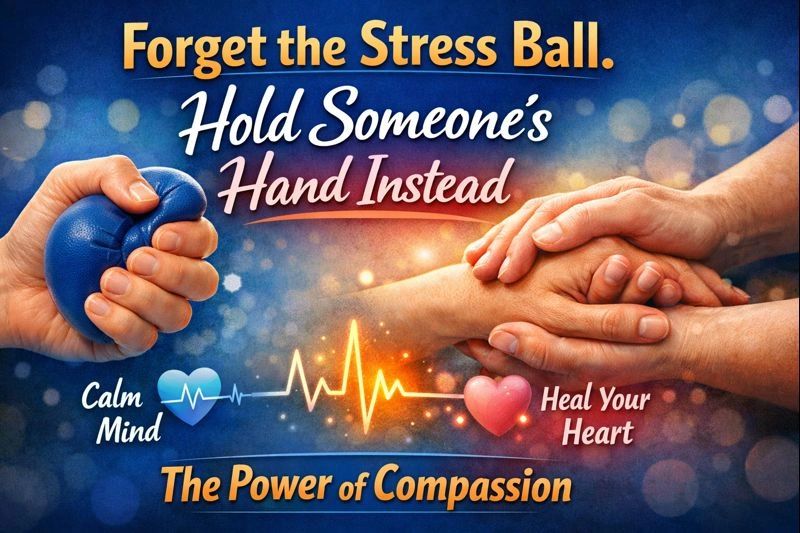
A fascinating study illustrates this biology in action. Researchers asked women to bring a loved one into the laboratory, then told them their loved one would receive a series of painful electrical shocks. Just to ensure the women understood the pain involved, they received a shock themselves first.
During some shocks, the women could hold their loved one's hand and think about supporting them through the pain. During other shocks, they squeezed a stress ball to manage their own distress about witnessing their loved one's suffering.
The researchers wanted to know which strategy was more effective at reducing the women's stress about their loved one's pain. What they found was striking.
When women held their loved one's hand and focused on providing support, their brain's reward system became more active. This is the area of the brain that creates a sense that something good will happen if we approach or take action. It underlies our experience of hope. Simultaneously, activity decreased in the amygdala, the brain's fear center.
When the women squeezed the stress ball and focused on managing their own distress? No benefit whatsoever. Not to how they felt, and not to what was happening in their brains.
This is a powerful metaphor for how healthcare providers often try to manage their stress. We can focus on ourselves (how can I suppress this stress, channel it, vent it) or we can step outside ourselves and look at who might be struggling and whether there's anything we can do to help. The research suggests that the second approach creates chemistry of hope and courage in ways that self-focused stress management simply cannot.
Compassion Training Creates Lasting Change
The meditation practices taught in compassion training programs (like loving-kindness meditation from Stanford's Compassion Cultivation Training) have been shown to produce the same neurological effects as physically holding and comforting someone who is suffering.
Research from Tania Singer's laboratory demonstrated this clearly. Participants learned a basic loving-kindness meditation technique and practiced it for a few minutes daily. Then researchers brought them back to the laboratory and had them watch news clips of people going through terrible situations, like parents whose child had recently died.
The people who had trained in loving-kindness meditation had a profoundly different emotional and neurological experience while witnessing this suffering. They experienced more positive emotion, more connection and hope, even as they witnessed pain. Their negative emotions didn't disappear; they still felt distressed to be aware of another person's suffering. But that distress was counterbalanced by feelings of love, connection, and hope.
Their brains reflected this difference. There was increased activation in the reward system while they watched people share their suffering, rather than the fear circuitry dominating the response.
Most remarkably, the participants were not doing the meditation while watching these videos. They had simply practiced compassion as a mindset for a few minutes each day. When confronted with suffering they couldn't do anything about, they were able to stay connected to care and hope rather than being overwhelmed by despair.
Caregiving Transforms All Stress
Researcher Stephanie Brown has proposed a revolutionary idea about stress management. When you activate the caregiving system by caring for anyone or anything (a child, a partner, a pet, even a plant), it transforms the nature of your own stress response regardless of the original source of stress.
You might be worried about work. You go home and care for your cat. That interaction, while you're connected to caregiving, transforms your stress response about work. By intentionally shifting into a caregiving mindset and mode, we can transform our experience of all stress so that we feel more hopeful about everything in our lives.
This helps explain some surprising research findings. In one series of experiments at Wharton, researchers looked at the psychological effects of either being told to spend time helping someone else or being given extra time for yourself. The outcome they measured was "time scarcity," that common feeling that there's too much to do and not enough time to do it.
Counterintuitively, people who were forced to spend time helping someone else (10 minutes or even 30 minutes) ended up feeling like they had more time. They experienced an increase in time affluence despite having actually lost time in their day. People who were given extra time for themselves? They ended up feeling like they had less time available.
The mechanism appears to be a shift in efficacy and hopefulness. Helping someone else makes people feel more capable of handling challenges in their own lives. It's not just a general positive mood; it's specifically an increase in the sense that "I can handle this."
Altruism Born of Suffering
One of the most profound findings in this research is that the people who experience the tend and befriend instinct most strongly are often those who have suffered the most. Looking at who volunteers, who feels natural empathy and compassion for others, and who cares for people outside their immediate households, it's frequently those who have experienced significant adversity in their own lives.
Psychologists call this altruism born of suffering. Our own contact with suffering tends to awaken the tend and befriend instinct.
A study at the University of Minnesota examined this relationship in young adults. The more traumatic events people had experienced in their lifetime (being a victim of crime, losing a parent, serious accidents, homelessness), the more time they spent helping loved ones and volunteering. When researchers followed participants over time, those who experienced new traumatic events subsequently increased their helping and volunteering behaviors.
Most importantly, the more time people spent volunteering or helping others after a trauma, the more they found meaning and purpose in their lives and the less likely they were to suffer from depression. Caring for others helped them cope with their own trauma.
The Antidote to Defeat
Understanding the tend and befriend instinct also illuminates its opposite: the defeat response. All social species, including humans, have a hardwired instinct to give up and stop using resources when there is nothing that can be done and no one in the community who cares.
The defeat response leads to loss of appetite, social isolation, the inability to believe anything you do could ever make a difference, and the conviction that there's no one in the world who cares. This response is probably one of the best predictors of both suicide and the kind of desperate violence we see in acts of terror.
The tend and befriend instinct may be our best resource for avoiding a defeat response in ourselves and helping prevent it in others who face great difficulties or feel isolated in their suffering.
The research consistently shows that for people in situations that could trigger defeat (surviving a natural disaster, living with chronic pain, losing a spouse, being the victim of a terrorist attack), being able to help someone else functions as a life raft:
People who volunteer after a tragedy feel more optimistic and less overwhelmed. Disaster survivors are less likely to develop PTSD if they help others during or immediately after the disaster. People with chronic pain who become peer counselors for others in pain experience reduced physical pain and disability. After losing a spouse, being able to care for anyone else helps relieve depression. After a heart attack, people who volunteer are less likely to experience depression and have a greater sense of hope.
In each case, something that could easily trigger despair or defeat is counterbalanced by connection to purpose and care.
Redemption Stories
A recent study interviewed adults in late midlife and asked them to tell the story of their lives. The researchers wanted to know what distinguished people who were making a difference in others' lives and experiencing the most psychological well-being.
The answer: these thriving individuals tended to tell what researchers call a redemption story. Their narrative was about their own contact with suffering, inspiring them to transform that suffering into something positive. They strongly believed it was possible to transform suffering into something good.
This is the story of people who are doing well at this stage of life. They used the suffering in their lives (their own suffering, or witnessing the suffering of loved ones or communities) as a catalyst to do something of value in the world.
Implications for Healthcare
For healthcare providers, this research carries profound implications:
Caring for others is protective, not just sustainable. The research on people who care for others outside their immediate households shows they are protected from the typical negative health consequences of stress. This isn't about caring less to protect ourselves. It's about caring in ways that activate the tend and befriend system rather than the defeat system.
Connection and service can be interventions. Programs that use caring as an intervention for vulnerable populations show remarkable results. At-risk youth trained as emergency medical technicians in their own communities don't just help others; they develop new identities as valued contributors rather than threats. Veterans with PTSD who train service dogs for other veterans experience decreased depression and intrusive memories while gaining a sense of purpose and belonging.
Self-care and other-care are connected. The tend and befriend research reminds us that reaching out for support and offering support are part of the same instinct. Healthcare providers often overdevelop the muscle for caring for others while atrophying the muscle of asking for help themselves. Both are essential components of sustainable caring.
The mindset can be trained. The meditation practices that create these neurological changes take only minutes per day. They don't require being physically present with someone in pain. They create a mental orientation that, when confronted with suffering, maintains connection to care and hope rather than overwhelm and despair.
The Practice
Stanford's Compassion Cultivation Training includes a simple practice that embodies this research: transforming suffering. The practice involves becoming aware of suffering (your own or someone else's), taking a moment to really feel it, witness it, and know it, and then connecting to your own intention to transform suffering into something positive.
That's it. Connect to the intention to transform suffering into something positive.
The beauty of this practice is that when we make that choice, when we bring that intention to mind, we have a whole biological system ready to back us up. We have the oxytocin ready to make us connected and brave. The tend and befriend instinct is there, waiting to be activated.
One of the most courageous things we can do is to choose, in the moment of suffering (when other instincts might tell us to back away, shut down, or feel defeated), to remember this intention and believe that we have the capacity to transform suffering into something better.
Healthcare providers entered this field to help others. The constant exposure to suffering (our patients' and our own) challenges this calling daily. But the solution isn't to care less. The science suggests the opposite: caring for others, when activated through the tend and befriend system rather than through empathic absorption, is one of the most powerful things we can do for our own resilience.
We are built for this.
Interested in learning more about sustainable caring in healthcare? Explore evidence-based approaches to compassion training and wellbeing systems ont my Science of Caring Well Blog
Watch the full talk here: Kelly McGonigal: The Science of Compassion and Altruism (Stanford CCARE)
References
Brown, S. L., Nesse, R. M., Vinokur, A. D., & Smith, D. M. (2003). Providing social support may be more beneficial than receiving it: Results from a prospective study of mortality. Psychological Science, 14(4), 320-327.
Fredrickson, B. L., Cohn, M. A., Coffey, K. A., Pek, J., & Finkel, S. M. (2008). Open hearts build lives: Positive emotions, induced through loving-kindness meditation, build consequential personal resources. Journal of Personality and Social Psychology, 95(5), 1045-1062.
Gilbert, P., McEwan, K., Matos, M., & Rivis, A. (2011). Fears of compassion: Development of three self-report measures. Psychology and Psychotherapy: Theory, Research and Practice, 84(3), 239-255. https://doi.org/10.1348/147608310X526511
Inagaki, T. K., & Eisenberger, N. I. (2012). Neural correlates of giving support to a loved one. Psychosomatic Medicine, 74(1), 3-7.
Jazaieri, H., McGonigal, K., Jinpa, T., Doty, J. R., Gross, J. J., & Goldin, P. R. (2014). A randomized controlled trial of compassion cultivation training: Effects on mindfulness, affect, and emotion regulation. Motivation and Emotion, 38(1), 23-35.
Kirby, J. N., Day, J., & Sagar, V. (2019). The 'Flow' of compassion: A meta-analysis of the fears of compassion scales and psychological functioning. Clinical Psychology Review, 70, 26-39. https://doi.org/10.1016/j.cpr.2019.03.001
Klimecki, O. M., Leiberg, S., Ricard, M., & Singer, T. (2014). Differential pattern of functional brain plasticity after compassion and empathy training. Social Cognitive and Affective Neuroscience, 9(6), 873-879.
Moieni, M., Irwin, M. R., Jevtic, I., Olmstead, R., Breen, E. C., & Eisenberger, N. I. (2015). Sex differences in depressive and socioemotional responses to an inflammatory challenge: Implications for sex differences in depression. Neuropsychopharmacology, 40(7), 1709-1716.
Poulin, M. J., Brown, S. L., Dillard, A. J., & Smith, D. M. (2013). Giving to others and the association between stress and mortality. American Journal of Public Health, 103(9), 1649-1655.
Rockliff, H., Gilbert, P., McEwan, K., Lightman, S., & Glover, D. (2008). A pilot exploration of heart rate variability and salivary cortisol responses to compassion-focused imagery. Journal of Clinical Neuropsychiatry, 5, 132-139.
Seppala, E. M., Hutcherson, C. A., Nguyen, D. T., Doty, J. R., & Gross, J. J. (2014). Loving-kindness meditation: A tool to improve healthcare provider compassion, resilience, and patient care. Journal of Compassionate Health Care, 1(1), 5.
Taylor, S. E., Klein, L. C., Lewis, B. P., Gruenewald, T. L., Gurung, R. A., & Updegraff, J. A. (2000). Biobehavioral responses to stress in females: Tend-and-befriend, not fight-or-flight. Psychological Review, 107(3), 411-429.