The Science of Caring WellJanuary 28, 2026 · 5 min read
Why the foundation of compassionate culture in healthcare isn't a policy or program, but a fundamental shift in how we relate to one another
Every computer runs on an operating system that determines how all other software functions. Install the most elegant applications on a corrupted OS, and they will inevitably malfunction. Organizations work the same way. Before we can build compassionate cultures in healthcare, we must examine the underlying motivational orientation that serves as our operating system.
Psychologist Jennifer Crocker, working with colleague Amy Canevello, has identified two fundamentally different ways humans relate to work and relationships. Understanding this distinction may be the most important step healthcare leaders can take toward sustainable wellbeing for their teams.
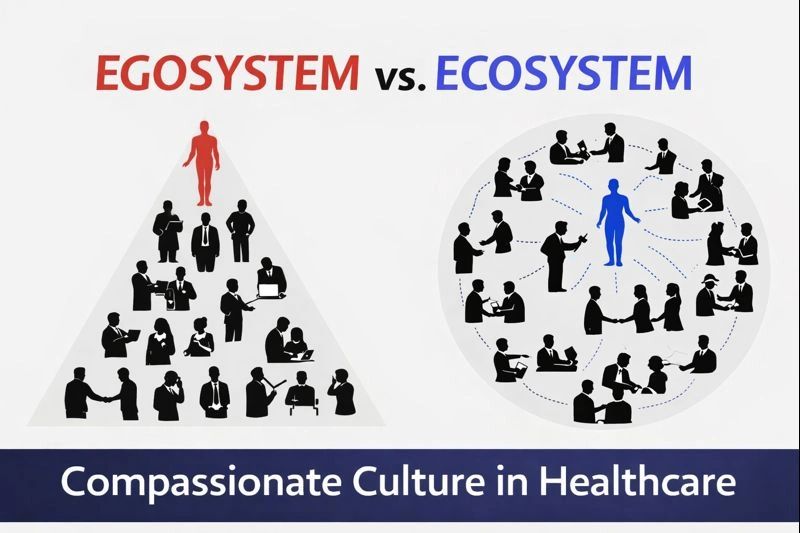
The Egosystem: When the Camera Zooms In
The egosystem perspective operates like a camera lens zoomed tightly on the self. People functioning from this orientation focus primarily on their own needs and view relationships through a competitive, zero-sum lens. There is a constant internal process of evaluating and judging, both oneself and others. Because I am judging, I expect to be judged. This creates a preoccupation with managing impressions that generates self-consciousness, social anxiety, and what Crocker calls "self-image goals," the drive to prove oneself and validate one's worth.
In healthcare settings, egosystem motivation is unfortunately familiar. It manifests as competitive environments where colleagues guard information rather than share it. It appears in blame cultures where the question "who is at fault?" takes precedence over "what can we learn?" It shows up as defensiveness about errors, reluctance to seek help, and an unwillingness to admit uncertainty, even when patient safety depends on it.
The egosystem feels protective. It promises that if we just work harder, prove ourselves more thoroughly, and manage our image more carefully, we will finally feel secure. This promise is a lie.
The Ecosystem: Widening the Lens
The ecosystem perspective widens the camera to include the whole frame. This orientation recognizes that the relationship between self and others is fundamentally non-zero-sum because the well-being of the system depends on the well-being of each part. Harm to one part ripples through, affecting everyone. Your struggle affects my ability to function. My burnout compromises your support system.
People operating from an ecosystem perspective prioritize others' needs, but not from self-sacrifice or martyrdom. They do so with a clear understanding of these interconnections and a genuine concern for collective well-being. Rather than feeling anxious and defensive, they feel clear and connected.
In healthcare, ecosystem motivation transforms the environment. Problems become opportunities for collaborative solutions. Errors become data for learning rather than evidence for prosecution. There is genuine concern for colleagues' well-being, not as a nicety but as an operational necessity. Teams recognize that patient care depends entirely on team functioning.
The Paradox of Self-Image Goals
Here is what the research reveals, and it should give every healthcare leader pause. Self-image goals, the characteristic pursuit of egosystem motivation, are associated with high emotional arousal: shame, anger, and sadness. They create exactly what they are trying to prevent.
People pursuing self-image goals paradoxically experience decreased regard from others, decreased self-esteem, and less secure relationships. The harder we try to prove ourselves, the less proven we feel. The more carefully we manage our image, the more fragile it becomes.
Compassionate goals, by contrast, are other-focused: wanting to be helpful and avoid harming others. People with compassionate goals view mistakes and failures as part of the human experience, warranting compassion rather than judgment. This orientation creates psychological safety, stronger relationships, and, counterintuitively, greater personal well-being.
Why This Matters for Healthcare Culture
This distinction is not merely academic. It is foundational. Compassionate culture requires ecosystem motivation as its operating system. Without this underlying orientation, even beautifully designed policies and programs will be subverted by competitive dynamics and self-protective behaviors.
Consider how many well-intentioned initiatives have failed in healthcare organizations. The wellness program that nobody uses because admitting you need support feels like weakness. The error-reporting system that captures only a fraction of near-misses because people fear blame. The team-building retreat that generates eye rolls because daily interactions remain competitive and guarded.
These failures are not evidence that wellness programs, error-reporting systems, or team-building are bad ideas. They are evidence that installing new software on a corrupted operating system produces corrupted results.
The Path Forward
The good news is that motivational orientation is not fixed. It can shift. Organizations can intentionally cultivate ecosystem motivation through specific, evidence-based practices.
In upcoming posts, I will explore ways to cultivate a compassionate culture to facilitate this shift: psychological safety, belonging and inclusion, mutual support, and shared purpose. Each aspect reinforces the others, and together they create conditions where ecosystem motivation can flourish.
But understanding the operating system comes first. Before asking "what programs should we implement?", leaders must ask "what motivational orientation are we reinforcing?" Before designing new initiatives, examine existing practices: Do they encourage people to prove themselves or to contribute to something larger? Do they foster competition or collaboration? Do they generate anxiety or clarity?
The most powerful intervention may not be adding something new. It may be recognizing and removing what is already undermining collective well-being.
Healthcare demands our best. Our patients deserve caregivers who are clear and connected, not anxious and defensive. Our colleagues deserve environments where helping others helps everyone, including themselves. Compassionate culture is not soft or idealistic. It is the operating system that allows healthcare to function as it should.
References
Crocker, J., & Canevello, A. (2008). Creating and undermining social support in communal relationships: The role of compassionate and self-image goals. Journal of Personality and Social Psychology, 95(3), 555-575.
Crocker, J., & Canevello, A. (2012). Consequences of self-image and compassionate goals. In P. G. Devine & A. Plant (Eds.), Advances in Experimental Social Psychology (Vol. 45, pp. 229-277). Academic Press.