
The Science of Caring WellSeptember 15, 2026 · 3 min read
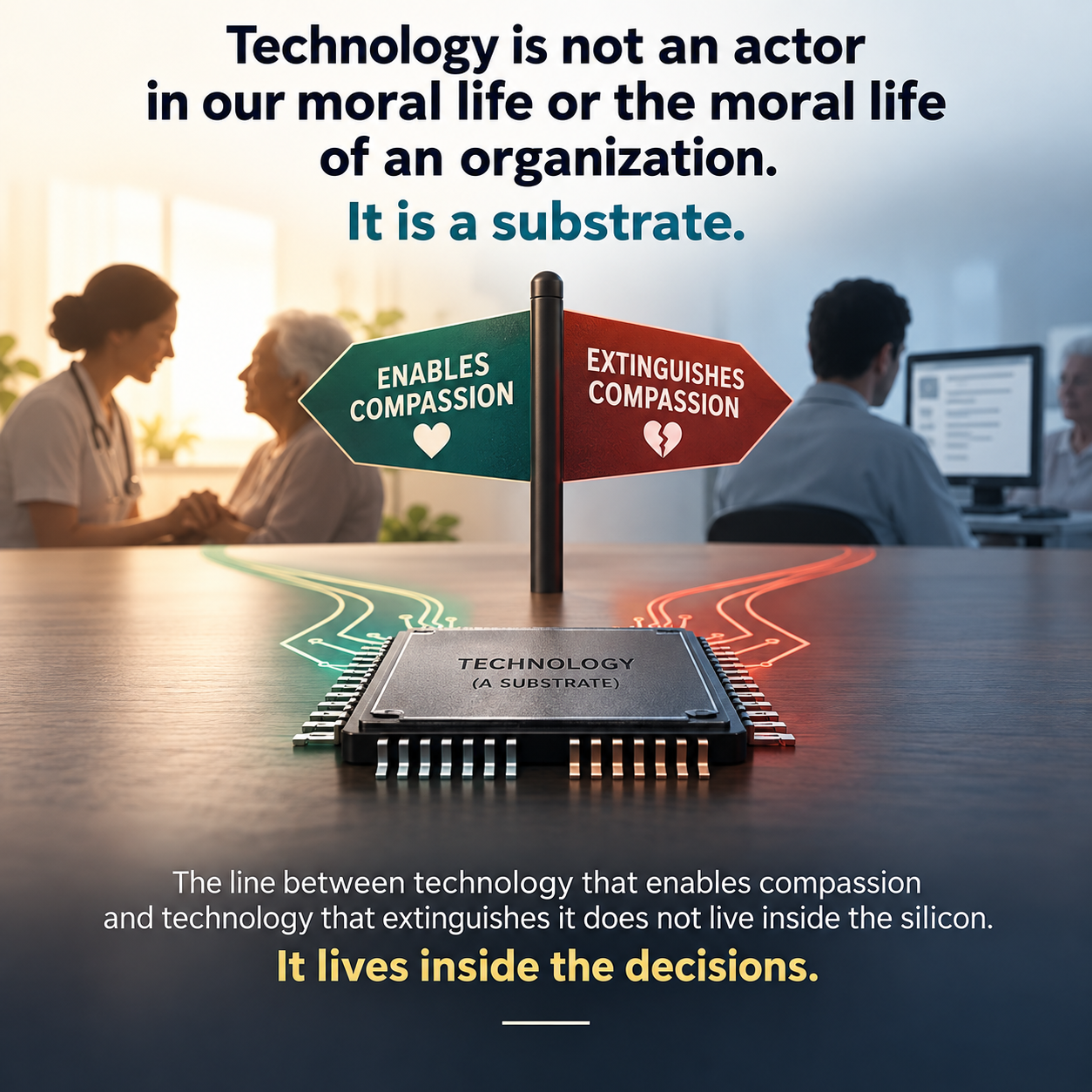
We like to talk about technology as though it has a will of its own. The electronic health record “makes” clinicians stare at screens. The monitoring system “keeps” an older adult safe. The app “connects” families. But technology does not act. It is a substrate — a surface on which human decisions are written. Whether a tool enables compassion or extinguishes it is not settled in the silicon. It is settled long before, in the choices about what to buy, why, for whom, and at what human cost.
That is worth slowing down on, because the same device can go either way depending entirely on the decisions surrounding it. So instead of asking whether a technology is good, ask better questions from wherever you happen to stand.
If you lead an organization
Think of the last technology your organization adopted. Was anyone asked, before purchase, “What will this do to the moments when a clinician and a patient actually see each other?” If not, who should have asked, and why didn’t they? The absence of that question is itself a decision, and patients live inside its consequences.
If you are a clinician
Is there a tool you use every day that you quietly blame for making you less present with patients? If you traced that frustration back past the screen, whose decision would you find at the end of the line? The screen is rarely the culprit. It is the visible end of a chain of choices made by people who never sat in the room with your patient.
If you are a student
If technology is only a substrate, can a well-intentioned organization build compassion-extinguishing systems without anyone ever making a cruel choice? What does that say about where moral responsibility sits in healthcare? The uncomfortable answer is that harm rarely requires cruelty. It requires only a series of reasonable decisions, each made without asking what it does to human presence.
If you prescribe
A device that keeps an older adult safely at home can also make it easier for family and clinicians to visit less. Whose job is it to make sure the technology extends human presence rather than replaces it? A safety tool that quietly removes the people is not neutral. Someone has to own the difference.
If you build
If you measured your product’s success by the minutes of human contact it gives back rather than the tasks it completes, what would you build differently? Efficiency and presence are not the same metric, and the one you optimize for is the one you get.
For everyone
If the patient could see every decision that shaped the tool in their home, which one would they most want to question? Design the tool as though they can see — because the person on the receiving end always feels the decisions, even when they cannot name them.
Technology is not an actor in our moral life or the moral life of an organization. It is a substrate. The line between technology that enables compassion and technology that extinguishes it does not live inside the silicon. It lives inside the decisions.