
January 10, 2026 · 12 min read
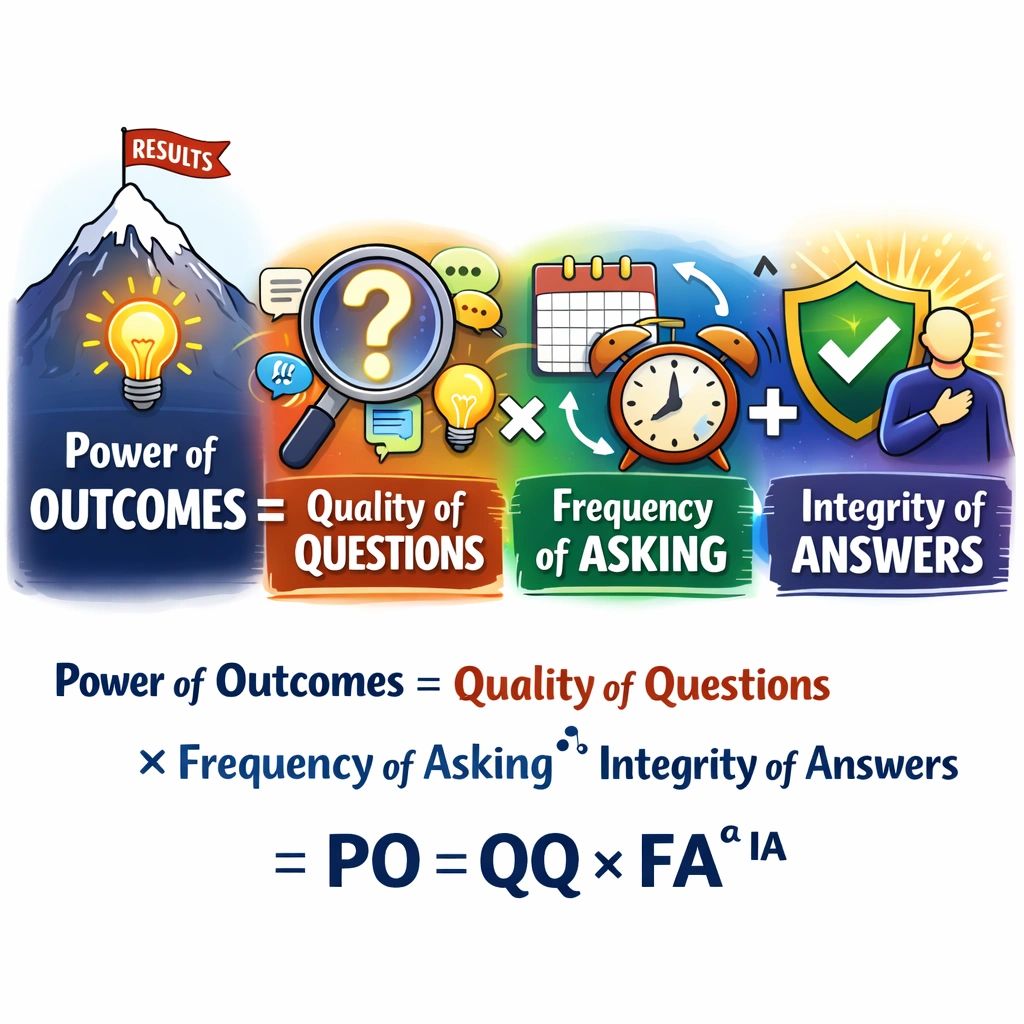
Sit with this statement: "The power of your outcomes is determined by the quality of the questions you ask yourself, multiplied by the frequency that you ask, raised to the power of the integrity of your answers."
For CEOs and founders building companies in healthcare, this formula isn't abstract philosophy. It's a survival strategy.
I've watched health-tech companies fail not because their technology was inadequate, but because their leaders asked the wrong questions, or asked the right questions and couldn't face the answers. I've seen founders optimize for problems that didn't matter while ignoring the questions that would determine whether their company existed in three years.
The graveyard of health-tech startups is filled with brilliant solutions built by people who never asked, or never honestly answered, the questions that mattered most.
Before reading further, I challenge you to consider what this formula means for your company.
What questions are you avoiding?
What answers are you unwilling to face?
Perhaps write down your thoughts before continuing.
I would love to hear what you discover.
1. Quality of the Questions You Ask Yourself
A high-quality question is not vague or comfortable. It is focused, purpose-driven, and connected to what actually determines success, not what you wish determined success.
In healthcare, founders often ask questions that feel strategic but avoid the hard realities:
- "How can we improve patient outcomes?" (Noble, but incomplete)
- "How do we build a better user experience?" (Important, but not sufficient)
- "How do we demonstrate clinical efficacy?" (Necessary, but not the whole picture)
These are good questions. But they are not the essential questions.
In Who's Paying and How Much Will They Pay?, I explored why these two questions determine whether a health-tech innovation lives or dies. The article examines how healthcare's fragmented economic architecture, where the person who uses the product is often not the person who chooses it, who is often not the person who pays for it, creates a maze that even the most innovative technology must navigate. Understanding this complexity is the starting point for asking questions that actually matter.
The essential questions in health-tech are harder:
- "Who is actually paying for this, and why would they?"
- "What has to be true about reimbursement for our unit economics to work?"
- "If we succeed clinically but fail economically, what happens?"
Neuroscience research shows that posing thoughtful, challenging questions stimulates areas of the brain linked with creative thinking, self-reflection, and decision-making. Over time, this habit strengthens neural pathways, making deep insight and problem-solving more natural. Asking yourself good questions literally changes how your brain processes information.
But here's what the research doesn't tell you: in healthcare, the quality of your questions must match the complexity of the ecosystem. A question that would be excellent in consumer technology may be dangerously incomplete in clinical settings.
Ten Questions to Pressure-Test Your Strategic Thinking
Before you finalize your next pitch, product roadmap, or funding round, ask yourself:
- Is my core question about value creation or value capture? Healthcare is filled with companies that created value but couldn't capture it. Am I confusing the two?
- Am I asking what the customer wants, or what the customer will pay for? In healthcare, these are often different. The patient wants convenience; the payer wants cost reduction; the provider wants workflow efficiency. Whose willingness to pay am I actually building toward?
- Does my question challenge my assumptions about the market, or confirm what I already believe? Am I seeking validation or truth?
- Am I asking about the technology, or about the adoption chain? A brilliant device means nothing if it can't be integrated into clinical workflows, documented for compliance, and billed successfully.
- Is my question specific enough to reveal uncomfortable answers? Vague questions produce comfortable non-answers. "Is there a market?" is vague. "Which CPT codes apply, what are the reimbursement rates, and what documentation is required?" is specific.
- Am I willing to ask questions that might invalidate my current strategy? The most important questions are often the ones we avoid because we fear the answers.
- Does my question address the full stakeholder ecosystem? Patient, clinician, administrator, payer, regulator: each has different needs and different decision criteria. Am I asking questions about all of them?
- Am I asking about the world as it is, or the world as I wish it were? Policy may change. Reimbursement models may evolve. But building a company on "should" rather than "is" is speculation, not strategy.
- Does this question open the door to meaningful problem-solving, or does it lead to a dead end? Some questions illuminate paths forward. Others just generate anxiety without insight.
- Does my question align with intellectual honesty, even when honesty is costly? The best founders ask questions that might reveal their idea won't work, because they'd rather know now than after burning through their runway.
2. Frequency: The Discipline of Continuous Inquiry
It is not enough to ask a great question once. Healthcare markets shift. Reimbursement policies change. Competitive landscapes evolve. The question you answered correctly eighteen months ago may have a different answer today.
Each time you revisit a strategic question, you give yourself the opportunity to see from new angles, update your assumptions, and uncover layers that were hidden before. Insight develops not only from the quality of your questions but from your willingness to stay with them, letting them evolve as your company and market evolve.
Cultivating a Questioning Culture
For founders and CEOs, the challenge extends beyond personal inquiry. You must build organizations where hard questions are welcomed, not suppressed.
This echoes the concept of "beginner's mind," a state of openness, curiosity, and freedom from preconceptions. The Zen teacher Shunryu Suzuki described it as: "In the beginner's mind, there are many possibilities; in the expert's mind, there are few."
In health-tech, expertise is essential. But expertise becomes dangerous when it closes you off to information that contradicts your mental models. The founder who "knows" the market may miss the shift that invalidates their assumptions. The CEO who "understands" the customer may not notice when customer needs evolve.
The Value of Structured Curiosity
Build regular practices of strategic questioning into your organization:
- Monthly assumption audits: What do we believe that we haven't tested recently?
- Quarterly "pre-mortems": If our company fails in two years, what will have caused it? What questions should we be asking now?
- Customer discovery that never ends: The questions you asked prospects before launch are not the same questions you should ask customers after deployment.
Curiosity is linked to greater resilience and adaptability. When you ask questions out of genuine curiosity, rather than to confirm what you already believe, you build organizational capacity to face uncertainty and respond to change.
What to Avoid: Ego-Driven Questions
Be mindful of questions designed to reinforce your existing narrative rather than challenge it.
Questions meant to make you feel clever, to prove you were right, or to shut down dissent are not inquiry. They are performance. They close off learning and, often, alienate the people whose honest input you need most.
The board member who asks gotcha questions. The CEO who frames questions to lead toward predetermined answers. The founder who asks "don't you agree that..." rather than "what am I missing?" These patterns feel like strategic thinking but actually prevent it.
Choose humility over certainty. The healthiest questioning culture combines confidence in your mission with humility about your assumptions. Be willing to acknowledge what you don't know. Take genuine interest in discovering where you're wrong. True strategic progress comes from the courage to be humble and the willingness to revise your beliefs when evidence demands it.
3. Raised to the Power of the Integrity of Your Answers
In mathematics, when you raise a number to a power, you dramatically increase its effect. In this formula, integrity is the exponent, the element that determines whether your questioning and persistence actually matter.
Integrity is more than honesty. It means wholeness, a commitment to truth even when truth is inconvenient, uncomfortable, or threatens your current path.
High-integrity answers are not the answers that feel good or preserve your ego. They are the answers that stand up to honest reflection, careful scrutiny, and a willingness to revise when reality contradicts your hopes.
What Integrity Looks Like in Health-Tech Leadership
Integrity means not settling for tidy answers that solve problems on the surface. When someone asks "Who's paying?" and you answer "Employers will pay because it reduces healthcare costs," integrity requires you to go deeper. Which employers? What's their decision process? What budget does this come from? Who has to approve? What's the sales cycle? Have you actually talked to them, or are you theorizing?
Integrity means not cherry-picking evidence. When your pilot data is mixed (some metrics improved, others didn't) integrity means presenting the full picture, not just the favorable results. When customer feedback contradicts your product thesis, integrity means taking it seriously rather than explaining it away.
Integrity means acknowledging when you don't know. Health-tech founders often feel pressure to project confidence, especially to investors and boards. But false confidence about market dynamics, reimbursement pathways, or competitive positioning is not strength. It's a vulnerability that compounds over time.
Integrity means being honest about your motivations. Are you building this company because you've validated a real market opportunity, or because you fell in love with the technology and are reverse-engineering a business case? Both can lead to successful companies, but they require different questions and different risk assessments.
The Compounding Effect of Integrity
Here's why integrity is the exponent in this formula: small deficits in honesty compound over time into strategic disasters.
The founder who slightly overstates product-market fit to close a funding round now has investors with misaligned expectations. The CEO who doesn't fully acknowledge a reimbursement risk builds a roadmap that ignores it. The leader who dismisses uncomfortable feedback creates a culture where uncomfortable truths go unspoken.
Each small compromise in integrity narrows your options and increases your fragility. Eventually, the accumulated weight of unacknowledged reality becomes unsustainable.
Conversely, leaders who maintain rigorous honesty (with themselves, their teams, their investors, their customers) build organizations capable of adapting because they're working with accurate maps of the terrain.
Why the Formula Works in Healthcare
If you ask superficial questions, ask infrequently, or refuse to face the full truth of your answers, your outcomes will be limited. You'll build products that solve the wrong problems. You'll pursue markets that don't exist. You'll burn runway on strategies that were never going to work.
When all three elements work together (focused questions, consistent inquiry, and integrity in your answers) your possibilities multiply. Not because the healthcare market becomes easier, but because you're finally seeing it clearly.
This is particularly critical in healthcare because the ecosystem punishes wishful thinking. In consumer technology, you can sometimes succeed with a flawed model if you move fast enough. In healthcare, the complexity of reimbursement, regulation, and institutional adoption means that foundational errors are difficult to recover from. The questions you fail to ask in year one become the crises you face in year three.
The Questions That Matter Most
Let me close with the questions I believe every health-tech CEO and founder must ask, and answer with integrity:
About your market:
- Who is actually paying, and what has to be true for them to pay?
- What's the decision-making process, and how long does it actually take?
- What are we competing against, including the option to do nothing?
About your product:
- Does this solve a problem someone will pay to solve, or a problem we think they should want to solve?
- What happens when clinical value doesn't translate to economic value?
- Are we optimizing for the patient experience while neglecting the institutional experience?
About your strategy:
- What would have to be true about the market for our current strategy to be wrong?
- What are we assuming about reimbursement, regulation, or adoption that we haven't validated?
- If we succeed clinically but fail to achieve sustainable unit economics, what's our plan?
About yourself:
- Am I asking hard questions, or am I asking questions designed to confirm what I already believe?
- What truth am I avoiding because facing it would require changing course?
- Do I have people around me who will tell me what I need to hear, not what I want to hear?
The Power of Your Outcomes
The quality of your outcomes, as a leader, as a founder, as a company, does not come from answers alone. It is shaped most by the depth of your questions, your commitment to keep asking, and your willingness to answer yourself with true integrity.
Healthcare will test all three. The market is complex enough to hide uncomfortable truths for years. The stakes are high enough that self-deception feels protective. The pressure is intense enough that honest answers can feel like threats.
But the founders who build enduring companies in this space are those who embrace the difficulty of these questions rather than avoid them. They ask what others won't ask. They keep asking when it would be easier to stop. And they answer with an integrity that keeps them connected to reality, even when reality is hard.
The formula works. The only question is whether you're willing to apply it.
References
Brown, K. W., & Ryan, R. M. (2003). The benefits of being present: Mindfulness and its role in psychological well-being. Journal of Personality and Social Psychology, 84(4), 822–848.
Gureckis, T. M., & Markant, D. B. (2012). Self-directed learning: A cognitive and computational perspective. Perspectives on Psychological Science, 7(5), 464–481.
Kashdan, T. B. (2009). Curious? Discover the Missing Ingredient to a Fulfilling Life. HarperCollins.
Kounios, J., & Beeman, M. (2015). The Eureka Factor: Aha Moments, Creative Insight, and the Brain. Random House.
Metcalfe, J., & Finn, B. (2020). Metacognition and control of study. Current Directions in Psychological Science, 29(3), 254–260.