
The Science of Caring WellJanuary 16, 2026 · 10 min read
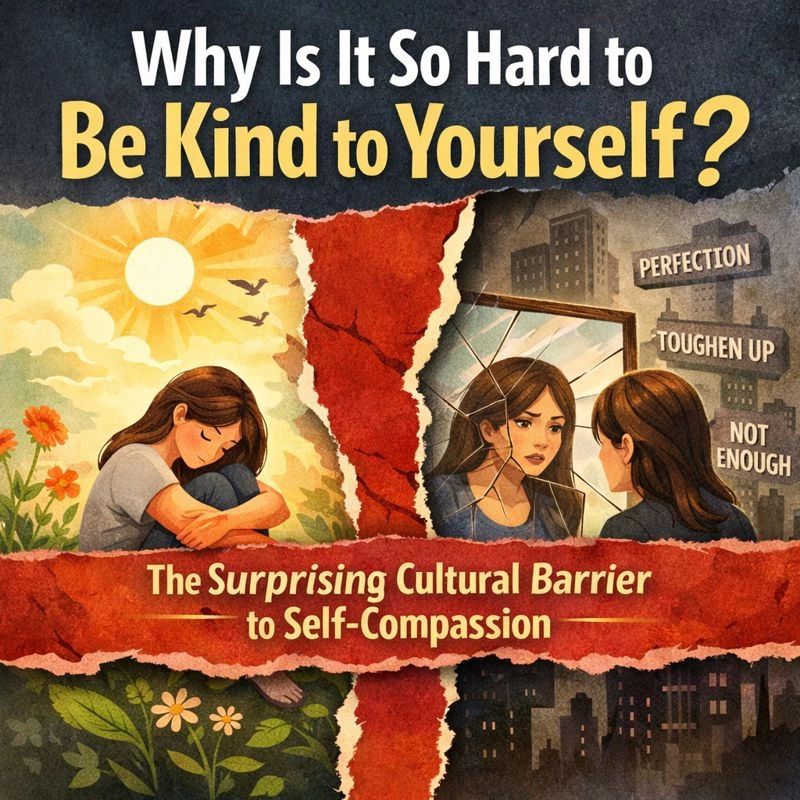
The Surprising Cultural Barrier to Self-Compassion
Abstract: When Thupten Jinpa, the Dalai Lama's principal English translator, introduced traditional Buddhist compassion meditation to Stanford students, he encountered an unexpected obstacle: Western students struggled intensely with the practice's foundational step of directing kindness toward themselves. This discovery echoes a moment from 1989 when the Dalai Lama himself was baffled by the Western concept of self-hatred, questioning how anyone could hate their very being. This article explores why self-compassion proves so difficult in achievement-oriented Western cultures, where individual identity becomes inseparable from accomplishment and self-worth depends on external validation. Drawing on research from psychologist Kristin Neff and the adaptations made to Stanford's Compassion Cultivation Training program, we examine how contemplative practices can be restructured for Western audiences and why self-compassion serves as the essential foundation for sustainable caring, particularly for those in helping professions at risk of burnout.
Estimated read time: 8 minutes or Listen on Speechify
Imagine sitting in a meditation class where the instructor asks you to close your eyes, focus on the one true object of unconditional love in your life, yourself, and silently repeat: "May I be happy. May I find peace and joy."
Simple enough, right? Now imagine that instead of feeling peaceful, you feel... uncomfortable.
Maybe even resistant.
Your inner critic starts to chatter, questioning everything about your supposed “self-love.” You wonder, "Am I really worthy of all this self-love?" You bristle against it, and it blocks you. Meditation over.
Or maybe it's more subtle. In a recent compassion cultivation class. Participants were asked to pair up and discuss moments when we both gave and received compassion.
After the exercise, the participants debriefed as a group, and an overwhelming majority felt much better about the times they gave compassion than when they received it.
Most people admitted they were uncomfortable receiving compassion, as though they didn't deserve it.
If this resonates with you, you are not alone. And the reason why may surprise you.
A Discovery That Changed Everything
Thupten Jinpa is a former Tibetan Buddhist monk who spent decades as the principal English translator for the Dalai Lama. In the early 2000s, he helped develop a compassion training program at Stanford University called Compassion Cultivation Training (CCT). The program was designed to teach people how to cultivate compassion in a secular, evidence-based way.
Jinpa drew on traditional Buddhist practices refined over 2,500 years. In these ancient traditions, compassion meditation (called metta or loving-kindness) always begins with yourself. The logic is straightforward: we naturally possess an instinct for self-care and self-love. The practice simply extends that natural warmth outward in ever-expanding circles, from yourself to loved ones, to strangers, to difficult people, and eventually to all beings everywhere.
Self-compassion, in this view, is the launching pad from which compassion for others takes flight.
But when Jinpa tested the program on American undergraduate students at Stanford, something unexpected happened.
The launching pad became a stumbling block. Many students reported feeling deeply uncomfortable when asked to direct kind wishes toward themselves. Some had outright aversive reactions to phrases like "May I be happy; may I find peace and joy." They could easily wish well for others but struggled intensely when the focus turned inward.
Jinpa realized they needed to completely restructure the program. "I realized we needed to start somewhere else," he writes in his book A Fearless Heart, "or we'd be stuck there, and I changed the order of the steps in the course."
When the Dalai Lama Was Baffled
This discovery echoed a pivotal moment from years earlier. In 1989, at a conference on Buddhism and psychotherapy in Newport Beach, California, the Dalai Lama encountered something that genuinely puzzled him: the Western concept of self-hatred.
During panel discussions, therapists described how self-hatred lay at the heart of many of their patients' problems. They asked how Buddhist techniques might help. His Holiness was baffled.
He questioned the very coherence of the concept. If self-preservation, self-care, and self-love are fundamental instincts of every sentient creature (as Buddhist psychology assumes), how could anyone hate their very being? How could we become so unhinged and alienated from our own nature?
The therapists had to work hard to convince him that self-hatred is not only a coherent concept but a psychological reality, one that is unfortunately common in the West.
Jinpa notes that His Holiness has since come to understand that self-hatred is rooted in the very same self-caring instinct. "Hatred is a form of caring," he explains. "We don't hate if we don't care. Self-hatred comes from caring a lot but being unable to accept or forgive our imperfect selves."
Why Self-Compassion Is So Hard in Western Culture
What makes self-compassion so difficult for people raised in Western, achievement-oriented cultures? The answer lies in how we construct meaning and identity.
Contemporary Western culture promotes individual autonomy, personal achievement, and self-reliance. These are valuable in many ways, but they come with a psychological cost. As Jinpa observes, when we cut ties of interdependency and move away from communal experience, the burden of making sense of our existence falls upon each person separately.
Since each of us must create our own meaning, we become obsessed with what we accomplish. We define our personal identity and evaluate our self-worth in terms of our work. The question "What do you do?" has come to mean so much more than simply asking about occupation.
The result? A harsh and judgmental relationship with ourselves. Many people believe that unless they are critical and demanding of themselves, they will be failures, unworthy of recognition and undeserving of love. If we listen carefully, there's often a voice in our heads relentlessly doubting: "Do I really deserve to be happy? Why should good things happen to me? Am I worthy of being loved?"
We crack the internal whip constantly, struggling against our judgmental selves, terrified that if we were gentle and kind with ourselves, we might not accomplish anything at all.
The Self-Esteem Trap
Western culture has tried to address this problem through the pursuit of self-esteem. Schools implement programs to boost children's self-esteem. Self-help books promise greater confidence and self-worth. But there's a fundamental problem with self-esteem as typically pursued.
Self-esteem is often tied to achievement. We feel worthy when we succeed and unworthy when we fail. This makes our sense of self-worth fragile and conditional. It requires constant external validation. And it often depends on being "above average," which, by definition, not everyone can be.
Psychologist Kristin Neff, who has devoted her career to studying self-compassion, found that achievement-dependent self-esteem makes us vulnerable to feelings of inadequacy and failure when things don't unfold as expected. When our purpose in doing something is the validation we anticipate from positive results, we are not well-equipped to deal with negative results. We either pretend everything is fine (denial) or we judge ourselves harshly.
Self-compassion offers a different path. Unlike self-esteem, self-compassion does not depend on being special or above average. It doesn't require constant success. Instead, it offers unconditional kindness toward ourselves, especially when we struggle, fail, or feel inadequate.
What Self-Compassion Actually Looks Like
Neff's research identifies three interrelated components of self-compassion:
Self-kindness versus self-judgment: Treating ourselves with warmth, patience, and understanding rather than harsh criticism when we face difficulty or failure. It means talking to ourselves as we would talk to a good friend.
Common humanity versus isolation: Recognizing that suffering, imperfection, and failure are part of the shared human experience. We are not uniquely flawed. Everyone struggles. Instead of asking "Why me?" we see "I am not alone."
Mindfulness versus over-identification: Holding our painful thoughts and feelings in balanced awareness rather than being consumed by them. We acknowledge the pain without making it our entire identity.
When all three components work together, they create a resilient internal system capable of meeting difficulty with both clarity and warmth.
What Research Reveals About Cultural Differences
Neff's research using the Self-Compassion Scale has been applied across many countries, both Eastern and Western. Interestingly, the self-compassion shortage is not strictly an East-versus-West issue; it appears to be widespread in modernity.
However, a study comparing self-compassion scores across the United States, Taiwan, and Thailand found Thailand's scores to be highest, with the United States a distant second and Taiwan last. Neff and her colleagues attribute Thailand's higher scores to their Buddhist cultural heritage, which emphasizes self-care as a foundation for caring for others.
This suggests that cultures with contemplative traditions built into their fabric may provide more natural support for self-compassion. In achievement-oriented Western cultures, self-compassion often feels foreign, something that must be deliberately cultivated rather than naturally absorbed.
A Different Starting Point
Because of what Jinpa discovered at Stanford, the Compassion Cultivation Training program was restructured. Instead of starting with self-compassion (where Western students got stuck), the adapted program now begins with directing loving-kindness toward a loved one, an "easy target" for generating warm feelings.
Think of someone in your life for whom you feel uncomplicated affection. Perhaps a beloved grandparent, a close friend, a cherished pet. Bringing this being to mind, you might silently offer:
May you be well.
May you be happy.
May you be healthy.
May you be free from suffering.
Once practitioners can reliably generate these feelings of warmth and care for others, they gently, gradually, turn those same practices toward themselves.
This represents a significant pedagogical adaptation of ancient contemplative practice for Western audiences. It acknowledges a reality that traditional Buddhist psychology didn't anticipate: that in achievement-oriented, individualistic cultures, extending kindness to yourself can be the hardest thing of all.
Why This Matters for All of Us
Self-compassion is not self-indulgence. It is not weakness. It is not letting yourself off the hook.
Research consistently shows that self-compassion is associated with greater emotional resilience, less depression and anxiety, better coping with stress, and more caring relationships with others. When we stop beating ourselves up, we actually have more energy and motivation to grow and improve.
For healthcare providers, educators, and others in caring professions, self-compassion is especially critical. It is the foundation that makes sustainable compassion for others possible. Without it, we risk burning out, depleting ourselves through what researchers now recognize as empathic distress fatigue rather than true compassion fatigue.
Jinpa's grandmother, an illiterate Tibetan woman who had lived a vastly different life from his own as an educated monk, once held his face in her hands and said simply: "Be kind, and be happy."
Over time, Jinpa came to realize this is the deal with compassion: It's not that we somehow have to make ourselves be kind and make ourselves be happy because that's how we "should" be. It's that being kind, to ourselves and to others, makes us happy.
If self-compassion feels difficult for you, know that you are not alone. Know that this difficulty is not a character flaw but a cultural inheritance. And know that with practice, patience, and perhaps a gentler starting point, it is possible to cultivate the capacity to be kind to yourself.
Because you deserve it. Not because you earned it. Simply because you are human.
* * *
References
Jinpa, T. (2015). A fearless heart: How the courage to be compassionate can transform our lives. Avery. https://www.amazon.com/Fearless-Heart-Courage-Compassion-Transform/dp/1594632626
Neff, K. D. (2011). Self-compassion: The proven power of being kind to yourself. William Morrow. https://self-compassion.org/the-book/
Neff, K. D. (2003). Self-compassion: An alternative conceptualization of a healthy attitude toward oneself. Self and Identity, 2(2), 85-101. https://doi.org/10.1080/15298860309032
Neff, K. D., Pisitsungkagarn, K., & Hsieh, Y. P. (2008). Self-compassion and self-construal in the United States, Thailand, and Taiwan. Journal of Cross-Cultural Psychology, 39(3), 267-285. https://doi.org/10.1177/0022022108314544
Raes, F., Pommier, E., Neff, K. D., & Van Gucht, D. (2011). Construction and factorial validation of a short form of the Self-Compassion Scale. Clinical Psychology & Psychotherapy, 18(3), 250-255. https://doi.org/10.1002/cpp.702
Klimecki, O. M., Leiberg, S., Ricard, M., & Singer, T. (2014). Differential pattern of functional brain plasticity after compassion and empathy training. Social Cognitive and Affective Neuroscience, 9(6), 873-879. https://doi.org/10.1093/scan/nst060
Singer, T., & Klimecki, O. M. (2014). Empathy and compassion. Current Biology, 24(18), R875-R878. https://doi.org/10.1016/j.cub.2014.06.054
Center for Compassion and Altruism Research and Education (CCARE). Stanford University School of Medicine. https://ccare.stanford.edu
Compassion Institute. Founded by Thupten Jinpa. https://compassioninstitute.com