January 10, 2026 · 13 min read
For over a decade, my primary occupation was to keep veterans safe in their homes. It was an honor and a privilege to defend their freedom to stay in their home safely and with dignity as time and circumstances presented complex challenges to that freedom.
During those years, I developed a systematic approach to home safety assessment that I've since refined and taught to clinicians, caregivers, and healthcare technology professionals. This framework views the patient's living environment as an ecosystem, one where physical abilities, built environments, social relationships, and technology all interact to determine whether someone can age in place successfully.
I've created a visual mindmap of this framework and recorded a comprehensive video lecture that walks through the concepts in detail. What follows is an overview of the key principles.
Why Home Safety Matters: The Fall Statistics
Before we dive into the framework, let's establish why this matters so urgently.
According to the CDC, one out of every four Americans over the age of 65 falls each year. They don't just fall; they hurt themselves, or they die. In 2021, 38,742 older adults died from preventable falls. Nearly 2.9 million were treated in emergency departments.
A 2020 analysis revealed that the majority of falls occurred in the home, with bedrooms, bathrooms, and stairs being the most common locations.
If fall prevention were the only thing we accomplished through home safety assessment, we would still be making a significant improvement in people's lives. But an effective home safety assessment accomplishes much more: it promotes independence, preserves dignity, and improves quality of life.
The 360-Degree Assessment: Impairments and Impediments
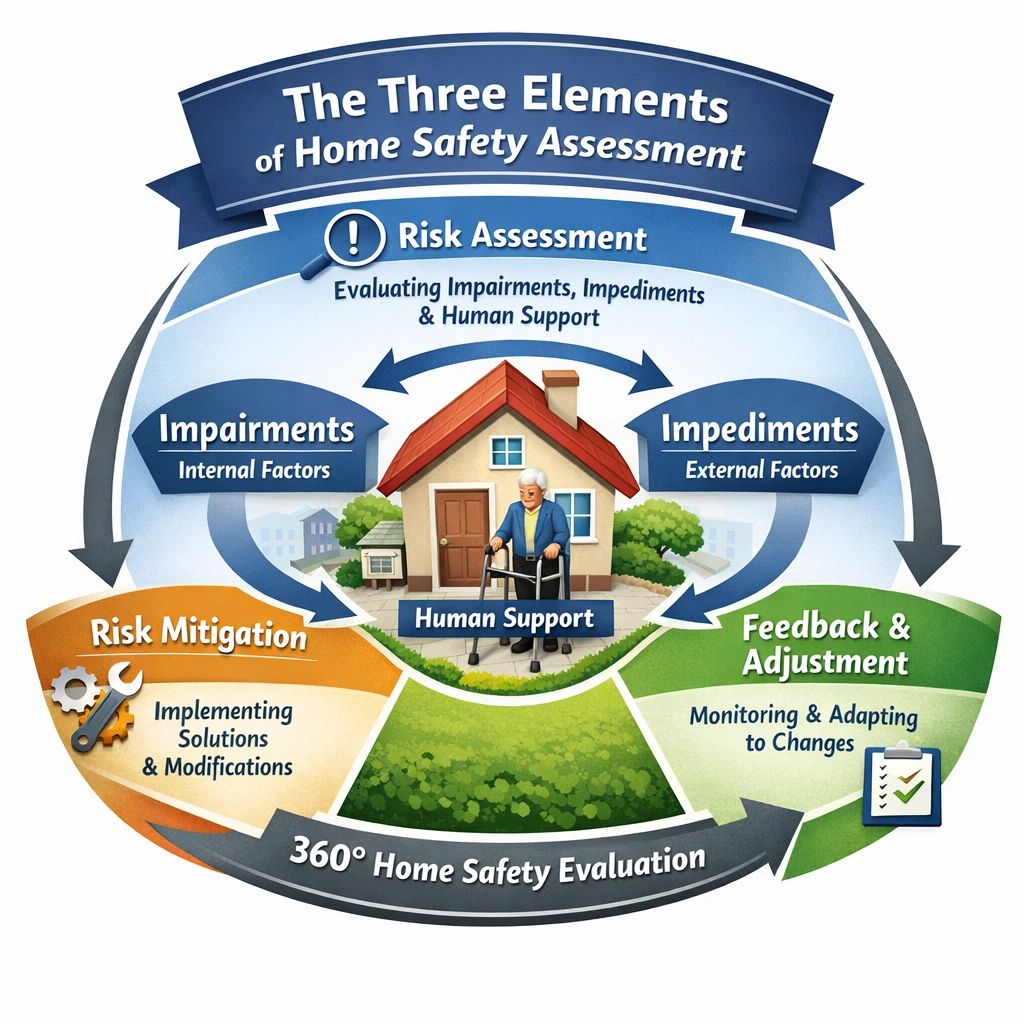
A home safety assessment is a 360-degree evaluation of a patient's whole living environment. It takes into account both impairments and impediments.
Impairments are conditions that come from within the person. As physical and occupational therapists, we understand impairments as an absence or significant difference in a person's ability to function, either physically or mentally. Impairments originate internally.
Impediments are barriers that come from outside the person. They exist within the environment and obstruct or hinder function. This term usually applies to built environments (a set of stairs, a door that's not wide enough) but also includes legal barriers, educational barriers, financial barriers, and social barriers. Impediments are external factors keeping people from operating at their optimal level.
Understanding this distinction is crucial. You can have a patient with minimal impairments who faces massive impediments, or a patient with significant impairments in an environment with few impediments. The interaction between the two determines the actual risk.
The Three Elements of Home Safety Assessment
The framework consists of three interconnected elements:
1. Risk Assessment
We need to understand the risks before we can do anything about them. This means evaluating impairments, impediments, and (perhaps most importantly) human support.
2. Risk Mitigation
What are we going to do about the things we find? This is where interventions come into play, from simple modifications to complex technological solutions.
3. Feedback and Adjustment Loops
This is a critically important aspect that often gets neglected. In systems theory, whenever you make changes to a system, you must continuously monitor whether your changes are having the desired effect. Other aspects of the system can change. The patient's condition can change. Your desired outcomes can change. Without feedback loops, you're flying blind.
Assessing Impairments: The Spectrum of Risk
Physical impairments exist on a spectrum. At one end, you have zero impairments: someone who is running triathlons and can operate in their home without modifications or risk. At the other end, you have severe dependence: someone who is bedbound with needs entirely different from someone moderately impaired.
Here's a counterintuitive insight: moderate impairment often presents the greatest risk. If someone is bedbound and confined to one room, our home safety assessment is somewhat limited. The circle of concern is confined. But someone with moderate impairment is out and about, going up and down stairs, getting in and out of cars, and entering and exiting restaurants. The geographical space we're concerned with increases dramatically, and so does the risk.
Cognitive impairments follow a similar spectrum, but with their own complications. Consider someone who is physically capable but cognitively impaired enough to wander. Their physical abilities actually increase their risk because they can get themselves into significant trouble.
There's another dimension of cognitive impairment worth mentioning: what we used to call "non-compliance." I never cared for that term because it suggests a power gradient. I prefer "non-adherence." When patients don't adhere to our recommendations, there's always a reason why. Sometimes it's cognitive. Sometimes it's practical. Sometimes we simply haven't understood their priorities. Getting to the root of non-adherence is essential for any home safety plan to succeed.
Assessing Impediments: The Four Categories
Impediments fall into four categories, each requiring different assessment strategies.
Architectural Impediments
When assessing built environments, I divide the patient's range into two categories: active zones and inactive zones.
Active zones are places the patient is likely to go regularly. For someone mildly impaired, this might include the grocery store and the coffee shop. For someone more significantly impaired, we focus on the confines of their home.
Within active zones, I identify essential spaces (bedroom, bathroom, living area) and essential passageways (the transitions between those spaces). I track the patient's normal activity flow during the day and map where they actually go. This creates a clear picture of where interventions will have the greatest impact.
Don't forget primary and secondary ingress and egress. Patients need to enter and exit the home by more than one route. If there's a fire blocking the primary entrance, there must be another way out.
A note on essential spaces: What determines whether a space is essential? It's not always obvious. I once worked with a veteran who wanted a stair glide to access his basement art studio. The VA initially denied it because a basement wasn't considered essential. After two years of advocacy, we finally made the case. The veteran went down to his studio, curated some of his old work, created new pieces, held an auction, and raised $250,000 for his own care. That "non-essential" basement was essential to his quality of life and, as it turned out, his financial survival.
When essential spaces are absolutely inaccessible, we get creative with adaptation strategies. Maybe we relocate the laundry from the basement to the main floor. Maybe we repurpose a dining room as a bedroom. Maybe we install a commode when a bathroom is unreachable. These aren't always ideal, but they allow people to remain in their homes.
Community Impediments
The patient's community affects their safety. Is it travelable? Is transportation available? Do they drive? Is the community itself safe? Is it accessible? A community might be safe with available transportation but lack sidewalks in a rural area, leaving no way to get from where the patient is to where they need to be.
Technological Impediments
This category is relatively new. 10 years ago, we didn't think much about technological impediments to home safety. Now, with advancing technologies in remote patient monitoring and remote therapeutic monitoring, connectivity matters. Moreover, more people are being cared for remotely. As I write this, I have the video feed of my 90-year-old mom's house up on an adjacent monitor.
Three factors determine technological impediments:
- Internet connectivity: Are they connected?
- Knowledge gap: Do the stakeholders understand how to use the technology?
- Predilection: How do the stakeholders feel about technology?
People fall into roughly three categories regarding technology.
Digital natives have never lived in a world without the internet and smartphones.
Digital adaptives (like me) grew up without these technologies but evolved with them and became proficient.
Digital-averse individuals avoid engaging with technology at all costs.
For digitally averse patients, we need extra care when introducing technological solutions. The knowledge gap is greatest for this group, requiring significant patient education to explain why these technologies might help them live safer and with a better quality of life.
Social Relationship Impediments
Social relationships can be impediments, too.
Research consistently shows that connectedness is a major indicator of happiness and longevity. Social isolation creates health risks that transcend simply being alone.
But the opposite extreme also presents problems. What if the patient is surrounded by toxic people? I once worked with a veteran whose grandson moved in and immediately started a drug trafficking operation out of the house. The safety implications were severe and extended far beyond what any physical modification could address.
The Human Factor: The Most Important Variable
Human support can be the single most important variable in any age-in-place strategy. It's determined by three factors:
Willingness: Is the potential caregiver willing to help?
Ability: Are they competent and capable? Consider this scenario: a 95-year-old patient whose primary support is a 75-year-old child who needs even more help than the patient. Willing, but not able.
Proximity: Are they close enough to provide the support needed? Someone might be willing and able, but live five states away. For remote caregivers, we employ different strategies, incorporating remote caregiving approaches and technology to bridge the distance.
Never underestimate the value of human support. It can equalize many other barriers. A caregiver can give someone an increased range in the community. They can compensate for physical limitations. They can provide the oversight that keeps technological solutions working.
Mitigation: Turning Assessment into Action
Let me illustrate with a case study.
John is a 68-year-old retired teacher and recent transtibial amputee due to diabetes. He faces significant challenges in his single-story home. The assessment highlights critical issues: five steps obstructing wheelchair access to his primary entrance, narrow doorways limiting mobility, and a bathroom lacking grab bars with glass shower doors.
The Ramp Problem
Most people imagine a simple ramp when they think about solving step access. The problem is that it's usually way too short.
The Americans with Disabilities Act requires a run-to-rise ratio of 12 to 1. For every inch of rise, you need one foot of ramp length. That's an 8.3% slope. If five steps are approximately 8 inches each, that's 40 inches of rise. Forty inches times 12 equals 480 inches, or 40 feet of ramp.
Additionally, ramps exceeding 30 feet require landings. Why? Because rolling up a 40-foot ramp is exhausting. You need a place to rest.
The simple little ramp patients envision actually needs to be a much more substantial structure. Preparing patients for this reality is part of the work.
The Doorway Problem
Stop reading and go to the bathroom, and observe the doorway.
A doorway has two openings: the available opening (molding to molding) and the functional opening (from the molding on the hinge side to the edge of the door when open). The door and its hardware obstruct that opening and often consume 2 or more inches of functional space.
Solutions vary in complexity. You can remove the door entirely and install a curtain, gaining the full available opening. This works well in bathrooms when the patient lives alone. Alternatively, offset hinges allow the door to close normally but pocket behind the doorway molding when open, significantly increasing the functional opening.
Sometimes those 2 inches are all someone needs to get a walker or wheelchair through safely.
The Bathroom Problem
Glass shower doors present multiple hazards. Fall into them, and you have a pile of broken glass. People constantly grab the door handles thinking they're grab bars, pulling the handles off or pulling the doors off their tracks. And the doors limit space for caregivers to assist.
My standard recommendation: remove the glass doors, install a curtain, and use a tub transfer seat. This allows the patient to sit outside the tub, slide over, and bathe safely. Add a handheld shower on a hose, ensure access to temperature controls (unless cognitive impairment makes that unsafe), and install properly anchored grab bars.
Technology: Simple, Cheap, Reliable, and Transparent
I started a home safety technology program at the VA and was initially excited to deploy advanced solutions. Automated lighting seemed straightforward. I used sophisticated sensors that communicate over the internet to control lights.
Then the internet had problems, and nobody could turn on their lights.
I learned that sometimes the simplest interventions are the best.
The goal of all technological interventions should be to address problems in the simplest, most cost-effective way possible. And ideally, the technology should be transparent to the user.
For automated lighting, I now use 12-volt LED light strips with battery backups and localized motion sensors, installed in baseboards and under beds. As people walk by, the floor lights up. Very simple. Very reliable. Battery backup means it works even when power goes out. And it's transparent: patients don't have to do anything.
I'm currently working on touchless fall detection using radar arrays that scan rooms and can identify when someone falls. This addresses the fundamental friction points of personal emergency response systems.
With traditional PERS devices, there are four friction points: getting the patient to agree to have the device, getting them to keep it charged, getting them to wear it, and (counterintuitively) getting them to actually press the button when they fall. The first symptom of a fall is often denial. Patients don't want to acknowledge they've fallen. Touchless detection removes all four friction points.
The principle: don't use technology for its own sake. Imagine the user experience.
What are you trying to accomplish?
What does the user experience look like?
If patients get the benefit without thinking about the technology, that's often the best solution.
Feedback and Adjustment Loops: The Forgotten Element
Follow-up falls into three categories:
Enhanced communication: Increased contact with caregivers, clinicians, and patients through telephone, video, text, email. Whatever increases the flow of information and allows you to ask important questions.
Revisits: Physical check-ins to ensure strategies are working. At the VA, I was fortunate to be part of a program where I could visit veterans as often as needed.
Technology: Remote therapeutic monitoring and remote physiological monitoring peripheries now enable continuous data collection. Imagine a device that tracks how many times someone gets out of bed. A bedmat transfers data to a central database where pattern analysis occurs over time.
If a patient starts getting up more frequently at night, that data might suggest increased risk for a urinary tract infection. UTIs often lead to conditions that lead to falls. We could screen for infections based on behavior patterns and treat them before they result in falls.
This is a simple example of predictive analytics, and it represents where healthcare may be heading with remote monitoring technologies.
Conclusion
Home safety assessment is not a checklist. It's a dynamic evaluation of an ecosystem where impairments, impediments, human support, and technology interact continuously. The most effective assessments address all dimensions, implement interventions appropriate to each patient's specific circumstances, and establish feedback loops to ensure ongoing effectiveness.
For a visual overview of this framework, explore the complete mindmap.
For a deeper dive into these concepts with demonstrations of ramp calculations, doorway modifications, and bathroom adaptations, watch the full video lecture.
The goal is simple, even when the execution is complex: help people stay in their homes safely, with dignity, for as long as possible. That was my mission for over a decade. It remains my mission today.