EducationNovember 22, 2026 · 12 min read
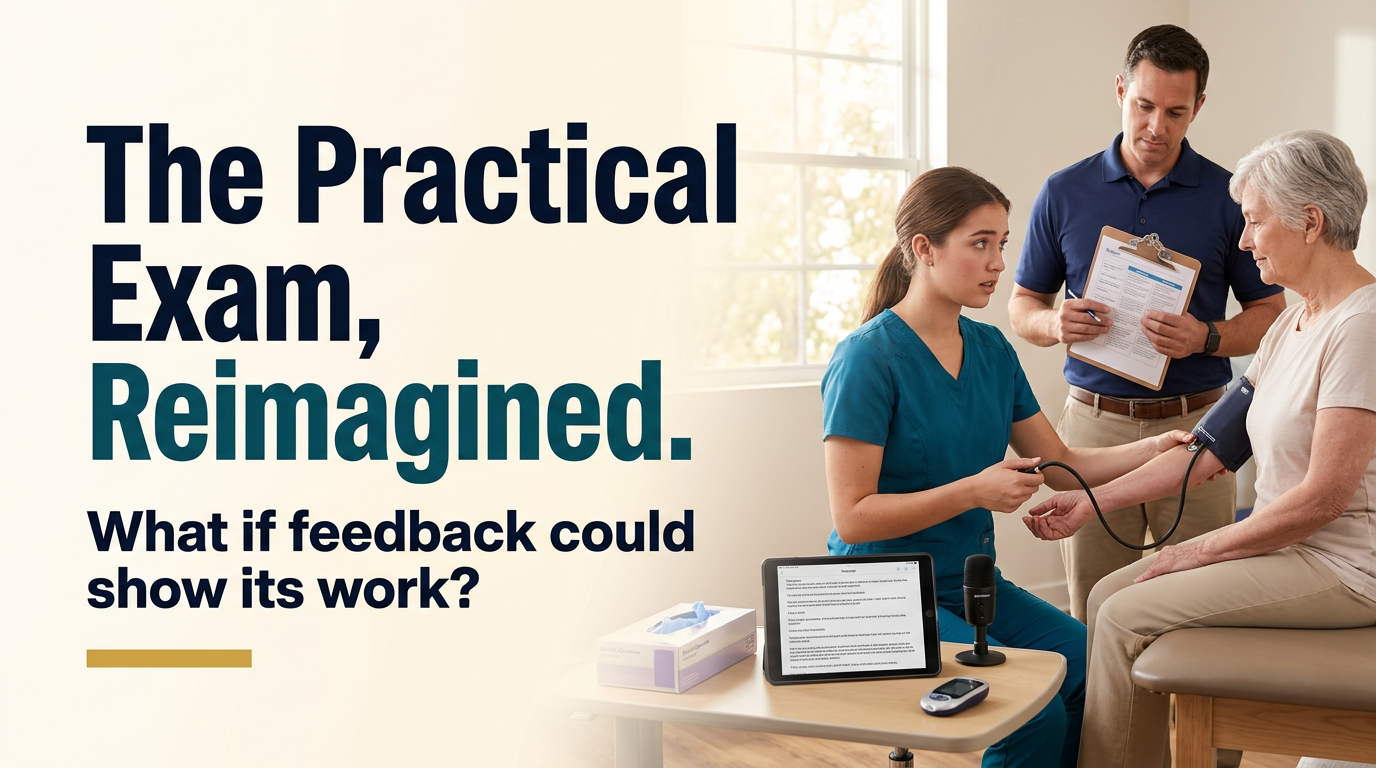
A nervous student. An examiner with minutes to spare. What happens when AI handles the words so the clinician can watch the hands?
The student: a performance with a grade attached
Maya has studied for two weeks. She has flashcards for lab values, a color-coded medication chart, and a roommate who has played the patient so many times she can recite the case herself. Maya knows this material.
Knowing it is not the problem. A written exam lets you think in private. A practical exam asks you to think out loud, with your hands on a patient, while the person who decides your grade stands three feet away holding a rubric. Every pause feels like it is being scored. Every time the examiner's pen moves, part of her attention leaves the patient and follows the pen.
The practical is a performance, and performance raises the stakes. Students who can explain orthostatic hypotension perfectly in a study group go blank when asked the same question in the exam room. Then it is over, and the second problem begins: Maya cannot remember what she actually said. Did she check the blood glucose before she stood the patient up, or only think about it?
Days later the feedback arrives. A score, and a comment: "Needed cueing on lab values. Review pharmacology." Which lab value? What did she say that was wrong? Where in the course is the right answer? The comment is honest and well meant. It is also nearly impossible to learn from.
The examiner: wanting to teach, with a clock running
On the other side of the rubric, the examiner is doing five jobs at once. Listening to the student's reasoning. Watching hand placement and body mechanics. Guarding the patient's safety. Deciding when a cue is fair and how to count it. Writing down enough of the student's words to justify the score later.
Then the door opens and the next student walks in. The time between students is measured in minutes, and those minutes are when the best feedback has to be written, while the details are fresh. Some examiners finish their comments that night from memory and shorthand, long after the moment has passed.
Adjunct examiners carry an extra weight. Many are excellent clinicians brought in for lab week who were not in the "room" for the Week 3 lecture. They know what they do in the clinic. They do not always know exactly what the slides said. When a student gives a blood pressure threshold that differs from the one the examiner has used for twenty years, who is right: the student, the course key, or the clinic?
With no time to check, the examiner falls back on clinical experience. That experience is valuable, but it is not always what the student was taught, and a student can lose points for repeating the course correctly.
So both people in the room are stressed, and both want the same thing. The student wants to show what she knows and find out exactly where she fell short. The examiner wants to be fair and to teach. The format works against both of them.
Why the right assessment needs the right feedback
It would be easy to read the last two sections and conclude that the practical exam is the problem. It is not. The practical is exactly the right assessment. What fails is the feedback that follows it.
The practical measures understanding, not recall. In my review of Understanding by Design, the central point is that knowledge is only raw material. Understanding shows when a student can explain, apply, and self-assess in a new, authentic situation. A multiple-choice item can tell you Maya recognizes the word "lisinopril." Only a performance can tell you she will check a standing blood pressure before the first transfer.
The difficulty is part of the value. As I wrote in C.O.R.E. Insights from "Make It Stick", effortful retrieval builds more durable learning than rereading ever will. Pulling knowledge out under pressure, hands on a patient, is retrieval practice at its most demanding. The stress Maya feels is the price of an assessment worth taking.
But retrieval without accurate feedback leaves the gap invisible. In Mighty Metacognition Meets CORE, I describe forecasting: students predict how they will do on a practical, then compare the prediction with the result. The distance between the two is where the learning lives. Maya cannot measure that distance if she cannot remember what she said and her feedback does not tell her. Overconfidence that is never corrected in school becomes clinical error later.
Appropriate feedback holds the standard and shows the way. WISE Feedback rests on three parts: a high standard, a stated belief that the student can meet it, and specific guidance on what to keep, what to change, and how to close the gap. "Needed cueing on lab values" delivers the standard and nothing else. Students revise when criticism reads as respect, and it reads as respect when it is specific.
The obstacle is time, not intent. In The Feedback Abyss, I named the gap between the feedback students need and what one instructor can realistically give. The practical exam sits at the bottom of that abyss: the richest assessment in the curriculum, followed by the thinnest feedback. That article's conclusion applies here. AI can deepen and personalize feedback and cross-reference course materials, but only when it amplifies a human's judgment and a human reviews every word before a student sees it.
So the question is not whether to keep the practical. It is how to give a true assessment of understanding the feedback it deserves.
Imagine a different exam
Now picture the same room with one change: the examiner's memory has help.
- The student consents. The encounter is recorded and transcribed with her permission. The record is treated as part of her education record, with the access and privacy rights FERPA gives her.
- The AI already knows the course. Before exam day, the instructor loads the syllabus, lectures, assigned readings, the case key, and the rubric. Nothing is graded against a generic idea of physical therapy. It is graded against this course.
- The examiner adds what only a clinician can see. Short contemporaneous notes capture hand placement, guarding, hygiene, and the judgment calls made in the room.
- The AI drafts, criterion by criterion. For each rubric box it pulls the student's exact words, the passage in the course material that applies, and evidence-based reading that supports the rationale.
- The examiner reviews and decides. Every comment and every score passes through a qualified practitioner before the student sees it.
The result is feedback that shows its work: what you said, what the course taught, what the evidence says, and why the rubric scored it the way it did.
What the feedback looks like
Take a complex-patient practical. The case is a patient recovering from multiple trauma and a concussion, with type 2 diabetes and hypertension, taking metformin and lisinopril, and with a wound to examine. The rubric has 21 criteria worth 5 points each. Scoring follows cues: 5 for no cue, 4 for one minor cue, 2 for two cues, 0 if the student cannot answer after two cues. Safety and professional behaviors are pass or fail.
Here is a slice of what Maya would receive.
Lab Practical Rubric: Case 1, Multiple Trauma and Concussion Excerpt, 4 of 21 criteria
Pharmacology Interpretation 5 / 5 pts
| 5 pts (Green) | 4 pts (Yellow) | 2 pts (Orange) | 0 pts (Red) |
|---|---|---|---|
| Awarded. Independently explains each medication's class, purpose, and implications for therapy. No cue. | Explains with one minor cue. | Explains with two cues. | Unable to explain after two cues. |
- Transcript [03:41]
- "Lisinopril is, um, an ACE inhibitor, so it lowers blood pressure, and I'd watch for dizziness when she stands up."
- Cues given
- None.
- Course material
- Week 3 lecture, Pharmacology for the Complex Patient: "ACE inhibitors reduce vascular resistance and lower blood pressure. Monitor for orthostatic hypotension, especially with position changes."
- Evidence
- Unlike beta blockers, ACE inhibitors do not blunt the heart rate response, so heart rate stays a usable guide to exercise intensity for this patient.
- Accuracy check
- Correct. Your class, effect, and precaution all match the course material.
- Why this score
- You named the drug class, explained its purpose, and tied it to a specific safety behavior without any cue.
- Next step
- Connect the drug to your plan out loud: "so I'll take a seated and a standing pressure before the first transfer."
Lab Value Interpretation 4 / 5 pts
| 5 pts (Green) | 4 pts (Yellow) | 2 pts (Orange) | 0 pts (Red) |
|---|---|---|---|
| Independently interprets lab values and adjusts the session. No cue. | Awarded. Interprets and adjusts with one minor cue. | Interprets and adjusts with two cues. | Unable to interpret after two cues. |
- Transcript [06:15]
- "Her glucose is 82... I think that's fine to exercise?"
- Cues given
- One minor cue. Examiner [06:22]: "What does your handout say about a reading in the low 80s before exercise?" Transcript [06:30]: "Oh. I'd give her a snack first and recheck."
- Course material
- Lab values handout, glucose section: "Check blood glucose before activity. For a low-normal reading, provide carbohydrate and recheck before exercise begins."
- Evidence
- Diabetes exercise guidance supports carbohydrate before activity at low-normal glucose, with the greatest concern for patients on insulin or secretagogues. Metformin alone carries a low hypoglycemia risk.
- Accuracy check
- Partly correct at first. A glucose of 82 is within the normal range, but the course asks for action on a low-normal reading before exercise. Your final plan was correct.
- Why this score
- You recognized the value and reached the right plan, but only after one minor cue. Your first answer was phrased as a question, which signaled uncertainty.
- Next step
- Reread the pre-exercise glucose section of the handout. Practice stating the value, the range, and the action in one sentence.
Vital Sign Stop Points Pending / 5 pts
| 5 pts (Green) | 4 pts (Yellow) | 2 pts (Orange) | 0 pts (Red) |
|---|---|---|---|
| Independently states correct parameters for holding or stopping activity. No cue. | States parameters with one minor cue. | States parameters with two cues. | Unable to state parameters after two cues. |
- Transcript [09:02]
- "I'd hold exercise if her resting pressure was over 200 over 110."
- Cues given
- None.
- Course material
- The case key lists a more conservative resting blood pressure threshold for holding activity.
- Evidence
- ACSM guidance uses a resting systolic above 200 or diastolic above 110.
- Accuracy check
- Your number differs from the case key but is supported by outside evidence. The key and the evidence disagree.
- Score pending
- You answered confidently and without a cue. Because your answer matches a recognized guideline, it has been sent to the course instructor to decide. A score of 5 is defensible if the evidence-based value is accepted. You will not lose points.
- Next step
- Know both numbers and where each comes from. In the clinic, being able to say "the facility protocol says this, and the guideline says that" is a strength.
Wound Examination 4 / 5 pts
| 5 pts (Green) | 4 pts (Yellow) | 2 pts (Orange) | 0 pts (Red) |
|---|---|---|---|
| Independently performs a complete wound exam with clean technique. No cue. | Awarded. Performs the exam with one minor cue. | Performs the exam with two cues. | Unable to perform after two cues. |
- Transcript [12:48]
- "I'm measuring length, width, and depth, and I'm checking for tunneling."
- Examiner observation (written during the exam)
- "Measured correctly, head to toe orientation. Touched the bed rail and kept the same gloves on."
- Cues given
- One minor cue. Examiner [13:05]: "Check your gloves." You changed gloves right away.
- Course material
- Wound lab skills checklist: "Measure length, width, and depth. Assess for tunneling and undermining. Change gloves after contact with any surface other than the wound."
- Not observable from the recording
- Glove changes, measurement orientation, and hand hygiene. These were scored only from the examiner's notes.
- Accuracy check
- Your verbal exam was complete and correct.
- Why this score
- Everything you said earned full marks. The one point lost is for clean technique, which the examiner saw and the recording could not.
- Next step
- Practice the wound exam with a partner who calls out every surface you touch. Clean technique is a habit of the hands, not of the words.
Rubric summary
Pass/fail criteria: Safety: Pass. Professional Behaviors: Pass.
Excerpt subtotal: 13 of 15 on the three scored criteria. One criterion is pending an examiner decision.
This example is a composite. Maya is not a real student, and the quotes, course references, and key are illustrative.
Three things stand out. Maya's strong answer is quoted back to her, so she knows what to keep doing. Her glucose answer shows the exact moment she needed the cue, and where to reread. And the Vital Sign Stop Points box is the one an overworked adjunct would most likely have marked wrong from habit. Here the disagreement is surfaced, both sources are named, and the instructor makes the call.
Where the proctor matters most
Look again at the Wound Examination box. The transcript says Maya measured the wound and checked for tunneling. Only the examiner knows she touched the bed rail and kept the same gloves on.
Audio misses the psychomotor half of the exam. Physical therapy is a hands-on profession, and the most important things in a practical never reach a microphone: where the hands are placed, how much force is used, how the student guards during gait, whether the patient is draped with dignity, which limb was actually tested, and what the patient's face did when the student moved her.
The most important things in a practical never reach a microphone.
For all of that, the examiner's contemporaneous notes are the only source. A well-designed tool respects this in three ways:
- It says what it could not observe. Any criterion that depends on sight or touch is marked "not scored" until the examiner enters an observation.
- It never assumes. A student who says "I'm washing my hands" has not been observed washing her hands.
- It gives the examiner's notes real weight. Proctor observations override the transcript whenever the two disagree.
This is where proctor feedback matters, and it is also where the technology pays the examiner back. An examiner who no longer has to scribble quotes can keep both eyes on the student's hands. The machine handles the words so the clinician can attend to the work that only a clinician can judge.
What has to be true for this to work
A vision like this earns trust only with guardrails built in from the start.
- Quotes must be verified. Student quotes come word for word from the transcript, filler words included. Course quotes are retrieved from the uploaded material, never recalled by the model. Likely transcription errors are flagged, not graded.
- The human owns the grade. The AI drafts. The qualified examiner edits, approves, and signs. Pass or fail decisions on safety are never made by software.
- Consent has to be real. Permission that feels mandatory is not permission. Students need a non-recorded path with equal standing, clear retention and deletion rules, and assurance their recordings are not used to train anyone's model.
- The course can be wrong. When the key and current evidence disagree, the system flags it for the instructor. That protects the student today and improves the course next term.
- Reasoning outranks recitation. Quotes explain a score. They do not generate it. A student who reasons soundly in her own words should never lose to one who parrots the slide.
A connection enhancer, not a connection inhibitor
Return to the room. Maya is still nervous. No technology removes the stakes of performing in front of someone who is evaluating you, and perhaps none should. But she walks out knowing that what she said was captured accurately, and that her feedback will point to the exact moment, the exact page, and the reason.
The adjunct examiner walks in with the whole course behind them. They no longer have to choose between their clinical experience and a lecture they never heard. They can bring both.
And the minutes between students change. They are no longer spent racing to reconstruct quotes. They can be spent on the thing students remember for years: an examiner who looks up, says "your patient felt safe with you, here is the one thing to work on," and means it.
Used this way, AI does not grade the practical exam. It makes the examiner's judgment transparent, consistent, and teachable. It turns a high-stakes performance into one of the best learning events in the curriculum, and it frees two stressed people in a small room to do what they came for: one to learn, and one to teach.
Related reading on Practical Innovations
- Understanding by Design (2nd Expanded Edition)
- C.O.R.E. Insights from "Make It Stick"
- Mighty Metacognition Meets CORE: Teaching Students to Think About Their Thinking in the Age of AI
- WISE Feedback: The Science of High Standards & High Support
- The Feedback Abyss: Using AI Without Losing Your Soul
- FERPA: What Every Educator Needs
Russ L'HommeDieu, DPT, ATP, CFPS, C-AAIS, is a physical therapist, educator, and founder of Practical Innovations, Inc. He serves as adjunct DPT faculty and a lab practical examiner.