EducationThe Science of Caring WellNovember 22, 2026 · 14 min read
The case in brief
Every health professions program (DPT, OT, PA, MD, DO, SLP and others) should require advanced, assessed training in AI use and AI ethics, taught by a designated AI navigator who also mentors students and faculty. Four findings support this position.
- AI is already in clinical practice. In the American Medical Association's 2026 survey, 81% of physicians reported using AI professionally, up from 38% in 2023 (American Medical Association [AMA], 2026).
- Curricula are uneven and mostly shallow. Most MD and DO schools now mention AI, yet about half lack an appropriate use policy (Association of American Medical Colleges [AAMC], 2025). This review found no equivalent national AI competency set for DPT, OT, SLP, or PA programs.
- AI changes how expertise develops. AI raises what a novice can produce today while lowering what the novice learns. Experts gain most safely because they can check the output. A graduate who never built the underlying skill cannot supervise the tool.
- Faculty readiness is the limiting factor. Learners are often more fluent with these tools than their supervisors (Abdulnour et al., 2025). A course without a prepared, available guide will not change behavior.
Where the evidence is thin or mixed, this paper says so. The argument does not depend on overstating it.
AI is already in practice and in students' hands
The question is no longer whether graduates will use AI, but whether anyone taught them how.
Clinicians. Physician use of AI rose from 38% in 2023 to 81% in 2026. In the same survey, 88% of physicians were concerned about potential skill loss, most of all those with 10 or fewer years in practice (AMA, 2026). The tools are also getting stronger. In a 2026 study in Science, a large language model outperformed physician baselines across five clinical reasoning experiments (Brodeur et al., 2026).
Students. Learners are not waiting for permission.
- In a 2025 survey of 552 medical students from at least 37 U.S. institutions, 87.0% used text-based generative AI and 74.7% used AI tools at least weekly. Only 50.3% felt confident evaluating AI-generated content, 12.2% used an institution-sponsored tool, and 64.2% wanted more training or clearer guidance (Bartnick et al., 2026). The authors caution that this is a convenience sample, not a national estimate.
- Nearly 400 students across twelve programs, including occupational therapy, physical therapy, physician assistant studies, and speech-language pathology, reported using generative AI but did not agree on when its use threatens academic integrity (Kazley et al., 2025).
- Among 211 health sciences students in Türkiye, 77.25% used AI to find health information, and 71.56% said AI made them less proactive and less curious as learners (Doğaner, 2026).
Use is high, confidence in judging the output is low, and institutional guidance is missing. That combination is the problem this course addresses. As one Practical Innovations article on a popular clinical AI tool advises: "Use it as a tool that augments your expertise, not one that replaces it" (Practical Innovations, 2026c).
Curricula have not kept pace
Medicine has started to respond. The rehabilitation and PA professions have further to go.
Medicine (MD and DO). The number of schools reporting AI in their curriculum rose from 88 in 2023 to 140 in 2024, and 107 of those 140 placed it in the required curriculum. Yet 52% of schools lacked an appropriate use policy, and only 30% gave learners secure access to an AI tool for learning (AAMC, 2025). In October 2026 the AAMC published national AI competencies in six domains, including professionalism and ethics and practice-based AI learning. Novice learners are expected to identify the risks of over-reliance and "never-skilling" (Howley et al., 2026). The target now exists. Implementation is just beginning.
All health professions. A consensus study defined six AI competency domains for health care professionals generally: basic knowledge, social and ethical implications, AI-enhanced clinical encounters, evidence-based evaluation of AI tools, workflow analysis, and practice-based learning (Russell et al., 2023). These translate directly to DPT, OT, SLP, and PA programs.
Physical therapy and allied professions. The American Physical Therapy Association adopted a 2024 House of Delegates position supporting the ethical integration of AI across practice, education, and research (American Physical Therapy Association [APTA], 2024). The published education research is still mostly perception surveys:
- In an early survey of 175 PT educators, administrators, and students, 61.1% had not used generative AI in the 2022 to 2023 academic year, and many held reservations (Severin & Gagnon, 2024).
- After a single AI case activity, 23 first-year DPT students reported more trust in AI to provide a diagnosis and a treatment plan, with no change in their views on the need for human oversight (Reoli et al., 2025). Exposure alone raised trust. It did not build judgment.
- When DPT students practiced interviewing with AI chatbots instead of peers, documentation errors rose. Prior level of function was recorded incorrectly in 65.7% of AI cases versus 9.7% of peer cases (Kaplan et al., 2026).
- A survey of 589 Italian physiotherapy students concluded that targeted training for students and faculty, backed by institutional guidelines, is needed (Tortella et al., 2025).
Open question. This review did not find AI-specific competency requirements from CAPTE, ACOTE, CAA, or ARC-PA. That should be confirmed directly with each accreditor before this paper is circulated.
Across regions, reviews identify the same barriers: limited formal training, uneven institutional readiness, and gaps in faculty expertise (Ren et al., 2026).
The expertise paradox
AI makes a master more capable and can keep a novice from becoming one. The research supports this claim, with one refinement that matters for how we teach: AI often improves a novice's output the most. What it threatens is the novice's learning.
Performance is not proficiency. In a study of 5,172 customer support agents, an AI assistant raised productivity 14% on average and 34% for novice and low-skilled workers, with minimal effect on the most experienced (Brynjolfsson et al., 2025). Read alone, that looks like good news for beginners. Studies that test people after the AI is taken away tell the rest of the story.
- Nearly 1,000 high school math students were given AI tutors. Unrestricted access improved practice scores, but those students then scored 17% worse than controls on an exam without AI. A tutor built with learning safeguards largely removed the harm (Bastani et al., 2025).
- In a randomized trial, developers learning a new programming library with AI help scored about 50% on a mastery quiz versus about 65% without it, and were not significantly faster. Participants who stayed cognitively engaged while using AI kept their learning (Shen & Tamkin, 2026). This is a preprint.
Judging the output takes expertise. A tool that is usually right is most dangerous to the person who cannot tell when it is wrong.
- Among 758 consultants, AI improved work on tasks within its capabilities. On a task chosen to lie outside them, AI users were 19 percentage points less likely to reach the correct answer (Dell'Acqua et al., 2026).
- When a purported AI system gave radiologists wrong mammography suggestions, accuracy fell at every experience level. It fell furthest for the least experienced: 19.8% correct for inexperienced readers versus 45.5% for very experienced readers (Dratsch et al., 2023).
- Among 319 knowledge workers, higher confidence in AI was associated with less critical thinking, and higher confidence in one's own skill with more (Lee et al., 2025).
The clinical education literature now names the risk. A New England Journal of Medicine review distinguishes deskilling (loss of skills once held), never-skilling (failure to develop them), and mis-skilling (adopting the AI's errors) (Abdulnour et al., 2025). Never-skilling is the risk specific to students. A commentary in The Lancet makes the same argument for preserving clinical skills (Berzin & Topol, 2025), and cognitive scientists warn that learners may not notice the loss as it happens (Macnamara et al., 2024).
| Study | Who | Finding | Limits |
|---|---|---|---|
| Budzyń et al. (2025) | Experienced endoscopists, 4 centers | Adenoma detection without AI fell from 28.4% to 22.4% after routine AI exposure | Observational, before and after |
| Goh et al. (2024) | 50 physicians, randomized | Access to an LLM did not improve diagnostic reasoning (76% vs 74%); the LLM alone scored higher | Vignettes, small sample |
| Bastani et al. (2025) | About 1,000 high school students | 17% worse unaided after unrestricted AI practice | Not health professions |
| Shen & Tamkin (2026) | Software developers, randomized | Lower mastery with AI assistance | Preprint, coding task |
The Goh trial deserves attention. Physicians given a strong AI tool did not reason better with it, which means working well with AI is itself a skill that no one had taught them.
What the evidence does not yet show. No trial has measured never-skilling in DPT, OT, SLP, or PA students. The strongest learning studies come from mathematics and software, and the clinical deskilling finding is observational. That is a reason to teach deliberately and measure the results, not a reason to wait. A profession that waits for proof of harm in its own graduates will have already produced them.
Teaching an AI mindset
Tools will change before today's first-year students graduate, so the durable outcome is a set of habits that keeps the clinician's own reasoning in charge. We call this an AI mindset.
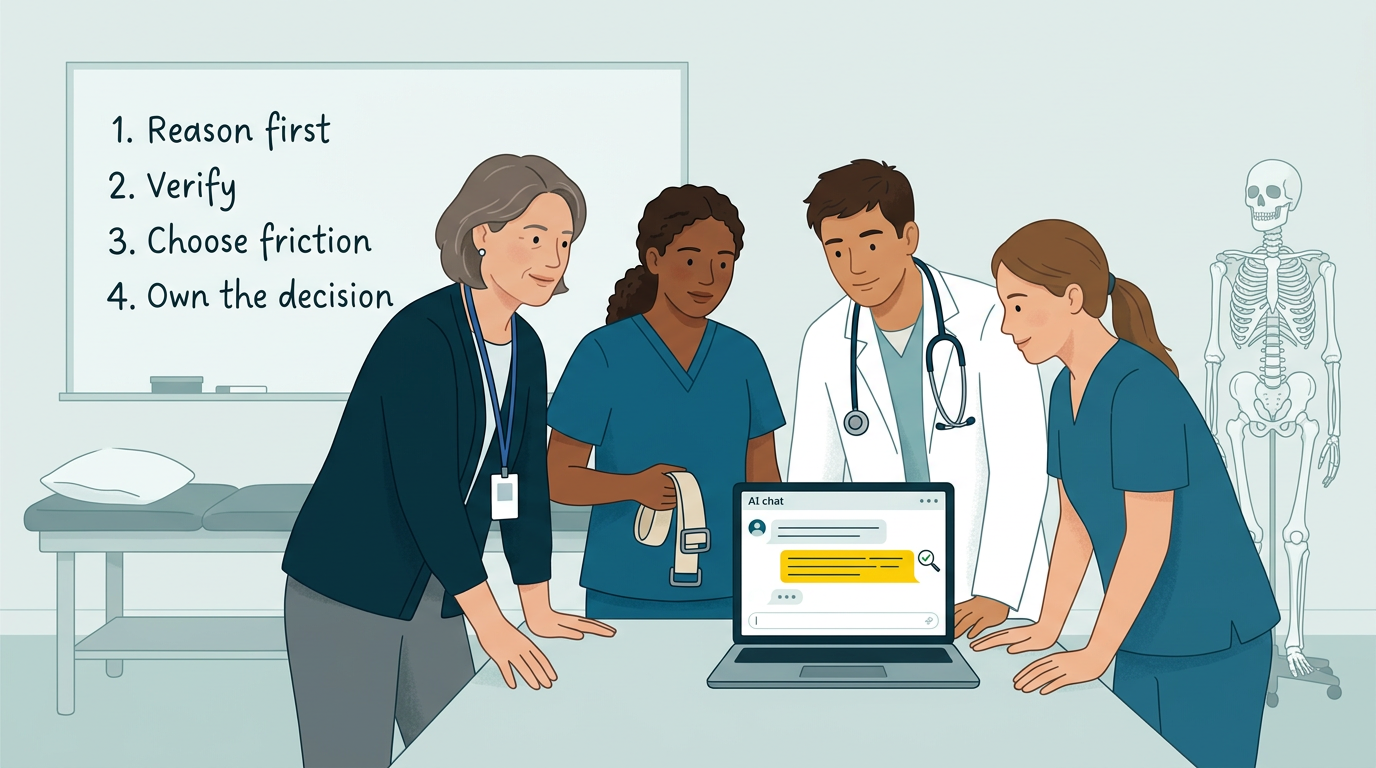
What it is. Four habits, each teachable and assessable:
- Reason first. Form your own assessment before asking the tool.
- Verify. Treat every output as a draft to check against evidence and the patient in front of you.
- Choose friction on purpose. Offload routine work. Keep the effort in tasks that build skill.
- Own the decision. Accountability never transfers to the software.
Why habits and not rules. The same studies that show harm also show the remedy.
- Design and use pattern decide the outcome. The AI tutor with learning safeguards avoided most of the damage that unrestricted access caused (Bastani et al., 2025), and learners who stayed cognitively engaged with AI preserved their skill (Shen & Tamkin, 2026).
- Confidence in one's own skill predicts critical engagement with AI output (Lee et al., 2025). Building real competence first is what makes later AI use safe.
- A survey of 666 people found that frequent AI use correlated with lower critical thinking scores, mediated by cognitive offloading, with younger participants more dependent (Gerlich, 2025). The study is correlational and was later corrected, so it shows association, not cause.
- A 2026 proposal in Academic Medicine for redesigning clinical reasoning education recommends five strategies, including reasoning-first AI workflows, graduated autonomy for AI use, and equipping faculty to supervise AI-assisted reasoning (Schaye et al., 2026).
- The NEJM review offers supervisors a structured approach, the DEFT-AI framework, for promoting critical thinking when a learner has used AI (Abdulnour et al., 2025).
The same idea in plain language. A Practical Innovations article describes two modes of AI use: reduce friction on information tasks, and add it on tasks meant to change you. In its words, "For transformation tasks, use AI to add friction" (Practical Innovations, 2026b). A second article puts the verification habit in one line: "The model provides a draft; the human provides the judgment" (Practical Innovations, 2026a).
Future-proofing. A graduate trained on one product is current for a year or two. A graduate trained to reason first, verify, and own the decision stays safe with whatever tool comes next. This is the protection against outsourcing critical thinking.
AI ethics as a core clinical competency
AI ethics belongs beside clinical reasoning, not in an elective, because the harms land on patients.
- Bias. A commercial algorithm used to manage care for millions of patients systematically underestimated the needs of Black patients because it predicted cost instead of illness. Correcting it would have raised the share of Black patients receiving additional help from 17.7% to 46.5% (Obermeyer et al., 2019). Clinicians who cannot ask what a tool was trained to predict cannot catch this.
- Fabrication. Language models produce confident, plausible errors, including citations to studies that do not exist. One Practical Innovations article argues this is a property of how the models work, not a defect awaiting a patch (Practical Innovations, 2026a).
- Privacy. In the AMA survey, 86% of physicians called data privacy critical to wider AI adoption (AMA, 2026). Students need explicit rules on what may never be entered into a consumer tool, starting with protected health information (Practical Innovations, 2026c).
- Accountability. Professional responsibility stays with the clinician. Competency frameworks expect clinicians to evaluate the quality, safety, and biases of AI tools and their underlying data (Russell et al., 2023), and to assess outputs for inaccuracies, bias, and inequitable access (Howley et al., 2026).
- Governance. The World Health Organization issued more than 40 recommendations on generative AI in health for governments, developers, and health care providers (World Health Organization [WHO], 2025).
- Human presence. Ethics also covers what a tool does to the clinical relationship. As a Practical Innovations article states, "Whether a tool enables compassion or extinguishes it is not settled in the silicon" (Practical Innovations, 2026e). The decision sits with the people who choose and deploy it.
Students see the stakes. In one survey, 89.57% of health sciences students believed AI use in diagnosis and treatment would lead to unethical outcomes, and readiness for medical AI rose with ethical values scores. The author recommends adding AI and ethics courses to the curriculum (Doğaner, 2026). Among U.S. medical students, 78.7% reported academic integrity or ethical concerns about AI (Bartnick et al., 2026).
Why "advanced." A single lecture can define bias. It cannot teach a student to question a tool's training data, recognize a fabricated reference, or decide what to tell a patient about AI's role in their care. Those are practiced skills and need repeated, assessed cases.
Why the course needs an AI navigator
The course should be taught by a designated AI navigator who also holds standing mentorship hours for students and faculty. Content is easy to find. A prepared person who stays current and is available is what programs lack.
Faculty are not yet ready to supervise AI use.
- Many learners are more fluent with large language models than the clinicians supervising them (Abdulnour et al., 2025).
- Reviews of AI in health professions education repeatedly identify gaps in faculty expertise and call for faculty development, governance, and assessment reform (Prasad et al., 2026; Ren et al., 2026).
- Equipping faculty to supervise AI-assisted reasoning is one of five core strategies proposed for redesigning clinical reasoning education (Schaye et al., 2026).
- Faculty development on AI works when it acknowledges fear of inadequacy and uses psychologically safe, individualized approaches (Merkebu & Samuel, 2026). That describes a relationship with a person, not a recorded module.
Someone has to own the infrastructure. Half of medical schools lacked an appropriate use policy and only 30% provided secure AI access (AAMC, 2025). Students across the health professions do not agree on what counts as acceptable use, and the authors of that study conclude that faculty should give specific guidance (Kazley et al., 2025). Without a named owner, these gaps persist.
There is precedent. Stanford appointed a director of AI medical education in 2025, followed by four associate directors, to scale its curriculum across 10 core clerkships and 205 residency and fellowship programs (Howley et al., 2026). The navigator role proposed here is the same idea sized for a single program or college.
What the navigator does. The role maps onto the three functions of a complete mentor described in a Practical Innovations article: "A complete mentor operates as a coach, a consultant, and a connector" (Practical Innovations, 2026d).
| Function | For students | For faculty |
|---|---|---|
| Coach | Builds the reason-first and verify habits; reviews how a student used AI on real work | Helps each instructor find safe, useful entry points without judgment |
| Consultant | Explains program policy, privacy limits, and what clinical sites allow | Advises on assignment and assessment redesign, policy, and accreditation expectations |
| Connector | Points to vetted tools, secure access, and current evidence | Links faculty to peers, training, and institutional resources |
Why one role does both jobs. Teaching the course keeps the navigator in contact with how students really use AI. Mentoring faculty spreads the same habits into every other course and clinical rotation, where they are reinforced. A course that stands alone is contradicted the moment students leave the room.
Limit of the evidence. No study has tested the navigator role itself. The case rests on documented faculty readiness gaps, the supervision literature, and institutional precedent. A program that adopts the role should evaluate it.
Objections and responses
| Objection | Response |
|---|---|
| The curriculum is already full. | The content threads through clinical reasoning, evidence-based practice, and ethics, which are already required. The cost of omission is graduates who never built skills they are assumed to have (Abdulnour et al., 2025). |
| The tools change too fast to teach. | That is the argument for teaching habits instead of products, and for a navigator who updates the material continuously. |
| Research shows AI helps novices most. | It improves their output (Brynjolfsson et al., 2025). When learning is measured after AI is removed, unguided use leaves novices worse off (Bastani et al., 2025; Shen & Tamkin, 2026). |
| Just prohibit AI until students are competent. | Students already use it weekly, mostly on tools their institution did not provide (Bartnick et al., 2026). Prohibition moves use out of sight and removes the chance to teach verification. |
| Brief exposure is enough. | A single AI activity raised DPT students' trust in AI for diagnosis and treatment planning without changing their views on oversight (Reoli et al., 2025). Exposure without critical training builds confidence, not judgment. |
| Existing faculty can cover it. | Faculty expertise is the most consistently reported gap (Prasad et al., 2026; Ren et al., 2026). Asking unprepared faculty to teach it guarantees uneven results. |
| The evidence is not specific to our profession. | True, and stated above. The mechanisms (automation bias, cognitive offloading, skill acquisition through effortful practice) are not profession-specific, and programs can measure outcomes as they implement. |
What we are asking programs to commit to
This paper makes the case. It does not design the course. Programs that accept the case should commit to six things.
- Require it. Make AI use and AI ethics a required, assessed, longitudinal thread in the core curriculum, not an elective or a single lecture.
- Sequence it for novices. Build foundational reasoning without AI first, introduce AI with deliberate friction, then move to supervised AI use in clinical education with graduated autonomy.
- Anchor it in published competencies. Adapt the AAMC domains (Howley et al., 2026) and the interprofessional competencies (Russell et al., 2023) to each profession.
- Appoint an AI navigator. Give the role protected time to teach the course, hold open mentorship hours for students and faculty, and keep content current.
- Set the conditions. Publish an appropriate use policy and provide secure, approved tool access.
- Measure it. Track unaided performance, verification behavior, and faculty confidence, so the program adds to the evidence that is currently missing for these professions.
References
Journal article details and DOIs were taken from PubMed records. Other links were opened on the date above. Practical Innovations articles list no individual author on the page, so they are cited with a group author; add a byline if you prefer.
Abdulnour, R.-E. E., Gin, B., & Boscardin, C. K. (2025). Educational strategies for clinical supervision of artificial intelligence use. New England Journal of Medicine, 393(8), 786–797. https://doi.org/10.1056/NEJMra2503232
American Medical Association. (2026, March 12). AMA: AI usage among doctors doubles as confidence in technology grows [Press release]. https://www.ama-assn.org/press-center/ama-press-releases/ama-ai-usage-among-doctors-doubles-confidence-technology-grows
American Physical Therapy Association. (2024, September 23). Ethical and effective integration of artificial intelligence across physical therapist practice, education and research (HOD P07-24-10-09). https://www.apta.org/apta-and-you/leadership-and-governance/policies/ethical-and-effective-integration-of-artificial-intelligence-across-physical-therapist-practice-education-and-research
Association of American Medical Colleges. (2025). Artificial intelligence curricula in U.S. and Canadian medical schools [Data snapshot]. https://www.aamc.org/media/84666/download
Bartnick, B., Shah, S., Sommers, S., Warren, R., Khosla, P., Mays, A., DeRegnaucourt, A., Wewer, A., Pienkowski, C., You, H. B., Mitchell, A., Ohno, Y., Lauinger, A., Bhagwagar, S. Z., & Xue, G. (2026). Generative artificial intelligence use among medical students: Learner perspectives for clinical educators. The Clinical Teacher, 23(6), Article e70531. https://doi.org/10.1111/tct.70531
Bastani, H., Bastani, O., Sungu, A., Ge, H., Kabakcı, Ö., & Mariman, R. (2025). Generative AI without guardrails can harm learning: Evidence from high school mathematics. Proceedings of the National Academy of Sciences, 122(26), Article e2422633122. https://doi.org/10.1073/pnas.2422633122
Berzin, T. M., & Topol, E. J. (2025). Preserving clinical skills in the age of AI assistance. The Lancet, 406(10513), 1719. https://doi.org/10.1016/S0140-6736(25)02075-6
Brodeur, P. G., Buckley, T. A., Kanjee, Z., Goh, E., Ling, E. B., Jain, P., Cabral, S., Abdulnour, R.-E., Haimovich, A. D., Freed, J. A., Olson, A., Morgan, D. J., Hom, J., Gallo, R., McCoy, L. G., Mombini, H., Lucas, C., Fotoohi, M., Gwiazdon, M., . . . Rodman, A. (2026). Performance of a large language model on the reasoning tasks of a physician. Science, 392(6797), 524–527. https://doi.org/10.1126/science.adz4433
Brynjolfsson, E., Li, D., & Raymond, L. R. (2025). Generative AI at work. The Quarterly Journal of Economics, 140(2), 889–942. https://doi.org/10.1093/qje/qjae044
Budzyń, K., Romańczyk, M., Kitala, D., Kołodziej, P., Bugajski, M., Adami, H. O., Blom, J., Buszkiewicz, M., Halvorsen, N., Hassan, C., Romańczyk, T., Holme, Ø., Jarus, K., Fielding, S., Kunar, M., Pellise, M., Pilonis, N., Kamiński, M. F., Kalager, M., . . . Mori, Y. (2025). Endoscopist deskilling risk after exposure to artificial intelligence in colonoscopy: A multicentre, observational study. The Lancet Gastroenterology & Hepatology, 10(10), 896–903. https://doi.org/10.1016/S2468-1253(25)00133-5
Dell'Acqua, F., McFowland, E., III, Mollick, E., Lifshitz, H., Kellogg, K. C., Rajendran, S., Krayer, L., Candelon, F., & Lakhani, K. R. (2026). Navigating the jagged technological frontier: Field experimental evidence of the effects of artificial intelligence on knowledge worker productivity and quality. Organization Science, 37(2), 403 ff. https://doi.org/10.1287/orsc.2025.21838
Doğaner, A. (2026). The ethical perceptions of health sciences students regarding access to health information via artificial intelligence: A cross-sectional study. Frontiers in Medicine, 13, Article 1930151. https://doi.org/10.3389/fmed.2026.1930151
Dratsch, T., Chen, X., Rezazade Mehrizi, M., Kloeckner, R., Mähringer-Kunz, A., Püsken, M., Baeßler, B., Sauer, S., Maintz, D., & Pinto dos Santos, D. (2023). Automation bias in mammography: The impact of artificial intelligence BI-RADS suggestions on reader performance. Radiology, 307(4), Article e222176. https://doi.org/10.1148/radiol.222176
Gerlich, M. (2025). AI tools in society: Impacts on cognitive offloading and the future of critical thinking. Societies, 15(1), Article 6. https://doi.org/10.3390/soc15010006
Goh, E., Gallo, R., Hom, J., Strong, E., Weng, Y., Kerman, H., Cool, J. A., Kanjee, Z., Parsons, A. S., Ahuja, N., Horvitz, E., Yang, D., Milstein, A., Olson, A. P. J., Rodman, A., & Chen, J. H. (2024). Large language model influence on diagnostic reasoning: A randomized clinical trial. JAMA Network Open, 7(10), Article e2440969. https://doi.org/10.1001/jamanetworkopen.2024.40969
Howley, L., Weems, K., Peoples, D., & Whelan, A. J. (2026). AI competencies across the learning continuum. Association of American Medical Colleges. https://www.aamc.org/about-us/medical-education/cbme/publication/ai-competencies-across-learning-continuum
Kaplan, K. B., Pravdo, A. M., & Reoli, R. (2026). Doctor of physical therapy students' perceptions of artificial intelligence chatbots versus peer role play for therapeutic interviewing practice. Physiotherapy Theory and Practice. Advance online publication. https://doi.org/10.1080/09593985.2026.2741350
Kazley, A. S., Andresen, C., Mund, A., Blankenship, C., & Segal, R. (2025). Is use of ChatGPT cheating? Students of health professions perceptions. Medical Teacher, 47(5), 894–898. https://doi.org/10.1080/0142159X.2024.2385667
Lee, H.-P., Sarkar, A., Tankelevitch, L., Drosos, I., Rintel, S., Banks, R., & Wilson, N. (2025). The impact of generative AI on critical thinking: Self-reported reductions in cognitive effort and confidence effects from a survey of knowledge workers. In Proceedings of the 2025 CHI Conference on Human Factors in Computing Systems (Article 1121). Association for Computing Machinery. https://doi.org/10.1145/3706598.3713778
Macnamara, B. N., Berber, I., Çavuşoğlu, M. C., Krupinski, E. A., Nallapareddy, N., Nelson, N. E., Smith, P. J., Wilson-Delfosse, A. L., & Ray, S. (2024). Does using artificial intelligence assistance accelerate skill decay and hinder skill development without performers' awareness? Cognitive Research: Principles and Implications, 9(1), Article 46. https://doi.org/10.1186/s41235-024-00572-8
Merkebu, J., & Samuel, A. (2026). Humanizing AI training for health professions educators. Medical Teacher, 48(3), 360–363. https://doi.org/10.1080/0142159X.2025.2522237
Obermeyer, Z., Powers, B., Vogeli, C., & Mullainathan, S. (2019). Dissecting racial bias in an algorithm used to manage the health of populations. Science, 366(6464), 447–453. https://doi.org/10.1126/science.aax2342
Practical Innovations. (2026a, January 12). Why AI hallucinates, why we can't simply fix it. /blog/why-ai-hallucinates-why-we-cant-simply-fix-it
Practical Innovations. (2026b, January 27). How to use AI to get authentically intelligent, not lazy. /blog/how-to-use-ai-to-get-authentically-intelligent-not-lazy
Practical Innovations. (2026c, February 27). OpenEvidence: What healthcare providers need to know. /blog/openevidence-what-healthcare-providers-need-to-know
Practical Innovations. (2026d, September 8). The perfect mentor does 3 jobs: Coach, consultant, and connect. /blog/the-perfect-mentor-does-3-jobs-coach-consultant-and-connect
Practical Innovations. (2026e, September 15). Technology is a substrate. /blog/technology-is-a-substrate
Prasad, P., Amin, M., Sari, E. F., Annamma, L. M., Narayanan, J., Yasothkumar, D., & Ahmed, M. (2026). Faculty development and institutional readiness for incorporating AI in health professions education: A narrative review. Frontiers in Dental Medicine, 7, Article 1874590. https://doi.org/10.3389/fdmed.2026.1874590
Ren, Y., Wang, Y., Dong, S., Su, W., Wu, Y., Liang, S., & Yang, X. (2026). Application of artificial intelligence in medical education: A systematic and narrative review of pedagogical potential and ethical implications. Advances in Medical Education and Practice, 17, Article 567190. https://doi.org/10.2147/AMEP.S567190
Reoli, R., Marchese, V., Duggal, A., & Kaplan, K. (2025). Student perceptions of artificial intelligence in Doctor of Physical Therapy education. Physiotherapy Theory and Practice, 41(10), 2112–2117. https://doi.org/10.1080/09593985.2025.2496978
Russell, R. G., Lovett Novak, L., Patel, M., Garvey, K. V., Craig, K. J. T., Jackson, G. P., Moore, D., & Miller, B. M. (2023). Competencies for the use of artificial intelligence-based tools by health care professionals. Academic Medicine, 98(3), 348–356. https://doi.org/10.1097/ACM.0000000000004963
Schaye, V. E., Parsons, A. S., Olson, A. P. J., Abdulnour, R.-E. E., & Daniel, M. (2026). Theory-informed redesign of clinical reasoning education in the era of generative artificial intelligence. Academic Medicine. Advance online publication. https://doi.org/10.1093/acamed/wvag318
Severin, R., & Gagnon, K. (2024). An early snapshot of attitudes toward generative artificial intelligence in physical therapy education. Journal of Physical Therapy Education, 39(3), 214–220. https://doi.org/10.1097/JTE.0000000000000381
Shen, J. H., & Tamkin, A. (2026). How AI impacts skill formation (arXiv:2601.20245). arXiv. https://arxiv.org/abs/2601.20245
Tortella, F., Palese, A., Turolla, A., Castellini, G., Pillastrini, P., Landuzzi, M. G., Cook, C., Galeoto, G., Giovannico, G., Rodeghiero, L., Gianola, S., & Rossettini, G. (2025). Knowledge and use, perceptions of benefits and limitations of artificial intelligence chatbots among Italian physiotherapy students: A cross-sectional national study. BMC Medical Education, 25(1), Article 572. https://doi.org/10.1186/s12909-025-07176-w
World Health Organization. (2025). Ethics and governance of artificial intelligence for health: Guidance on large multi-modal models. https://www.who.int/publications-detail-redirect/9789240084759